
Birding Northern Greece: Lake Kerkini and the Dalmatian Pelicans
Leaving the coast near Thessaloniki, we were driven roughly 100 kilometers (62 miles) north into Central Macedonia, toward the Bulgarian border and the southern edge of the Balkan Peninsula. The destination was the small village Chrysochorafa, on the eastern shore of Lake Kerkini, approximately 23 kilometers (14 miles) from the Promachonas border crossing into Bulgaria. Across the water rose the Kerkini Mountains — known internationally as the Belasica range — forming the natural boundary between Greece and Bulgaria. The highest peak reaches 2,031 meters (6,663 feet), and in January those upper ridges were snow-covered while the lake basin below sat low and often muted in winter light - we experienced fog and drizzle, snow and even bright blue sky days during my stay.
About Lake Kerkini
Lake Kerkini lies at roughly 35 meters (115 feet) above sea level and is not a natural lake. It was first created in 1932, when a dam was constructed to control flooding and regulate the Strymonas River (called the Struma in Bulgaria). Over time, sediment reduced the lake’s capacity, and a new modern dam was completed in 1982 near Lithotopos to stabilize water levels for irrigation, flood control, and hydroelectric management.
The Strymonas rises in Bulgaria, flows south into Greece, feeds Lake Kerkini, and continues across the Serres plain before forming the Strymonas Delta and emptying into the Aegean Sea. It is a transboundary river system linking Balkan mountains to Mediterranean coast. The surrounding plain is intensely agricultural — rice fields, cotton, almond and walnut orchards — with herds of Greek water buffalo grazing alongside the wetlands. In this unique ecosystem, I spent four full days — sunrise launches and early winter sunsets — in the presence of Dalmatian Pelicans.
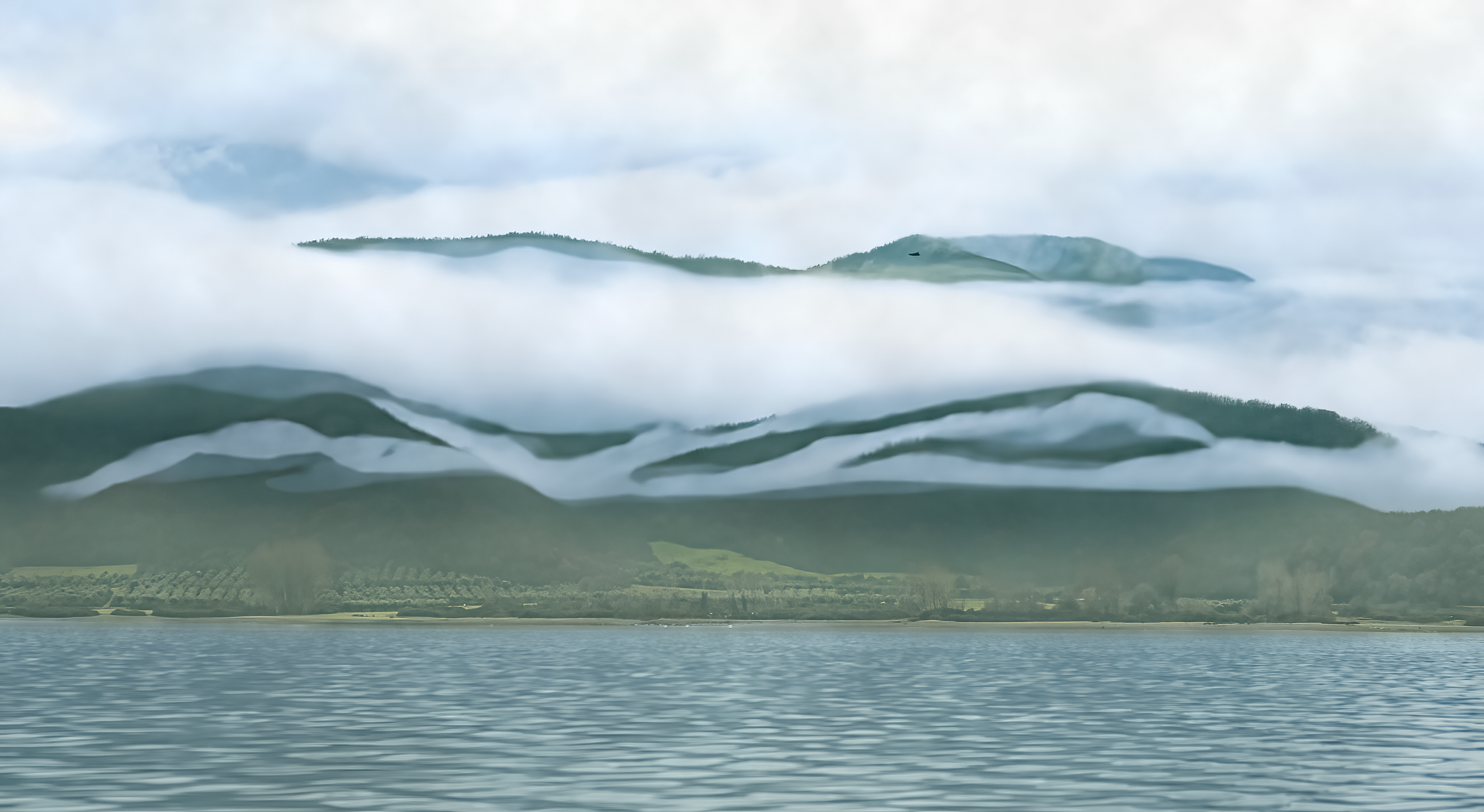
Lake Kerkini Shoreline
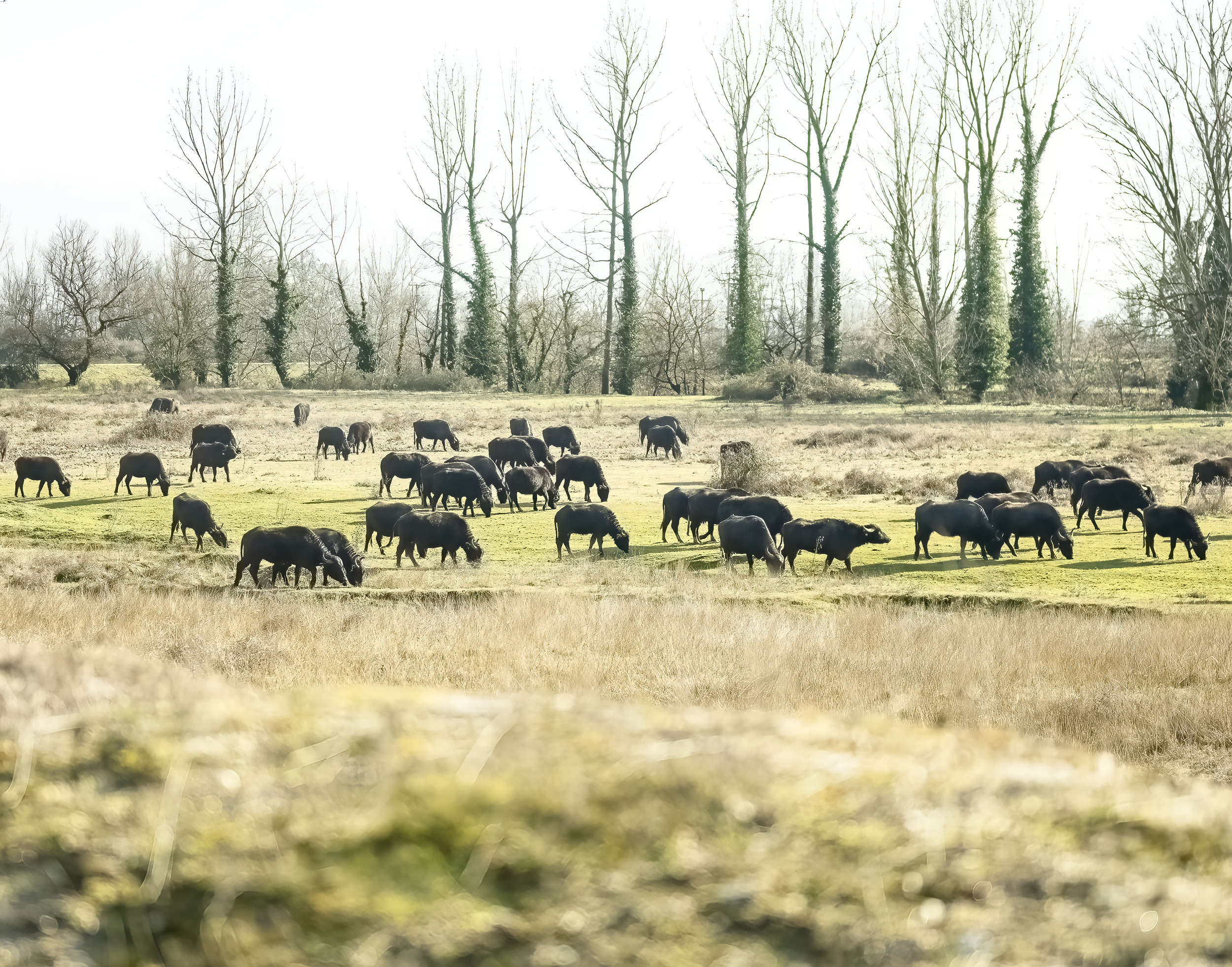
Water Buffalo
Our group stayed in Limneo Guesthouse, a family-run hotel in Chrysochorafa. Limneo translates to “kingfisher” in Greek — like the Common Kingfisher I spotted on the first day along the wetlands outside Thessaloniki. From the village I could hear Song Sparrows singing from my balcony, and down the street a Little Owl stared out from the open window of an abandoned stone building. At night, Golden Jackals called, screamed really, and during the day we saw them moving through the agricultural fields hunting.
One afternoon I took a walk up the hill from the guesthouse. It was a steep climb into the hillside. Along the road I passed a small olive grove and almond trees, dormant now in winter. I also passed a typical roadside Greek chapel — white with terracotta. These small roadside shrines are often called kandylakia or eikonostasia in Greece, and they may be placed as memorials, as thanks for protection, or simply as a place for passing travelers to stop and say a brief prayer. On that walk I added several life birds to my list: Common Chaffinch, Common Firecrest, Goldcrest, Long-tailed Tit, Great Tit, European Goldfinch, Redwing, Song Thrush, and a loud Eurasian Jay
Why Lake Kerkini in Winter: The Dalmatian Pelicans
I came to Lake Kerkini to photograph the Dalmatian Pelican — and winter is when this lake matters most to them.
Dalmatian Pelicans in southeastern Europe are generally short-distance migrants. They do not undertake extreme, transcontinental journeys; instead, they move within the Balkans and eastern Mediterranean in search of ice-free water and reliable fish. Lake Kerkini provides both. As a managed reservoir on the Strymonas River, the lake typically maintains open water through winter and broad, shallow areas where pelicans can feed efficiently. That combination — accessible fish and shallow foraging habitat — is why they gather here.
Some birds move within this regional Balkan system depending on conditions. Others are associated with major breeding colonies such as on Lake Prespa, an alpine lake that sits about 3,000 ft above sea level at the tripoint of Albania, North Macedonia and Greece. The lake hosts one of the largest Dalmatian Pelican breeding populations in the world. One of our guides, Vassili, lives near Lake Prespa year-round and works with the pelicans there during the breeding season. In winter, he comes down to Lake Kerkini to guide on the boats. His connection to both lakes underscored how closely linked these wetlands are within the species’ range.
The global population of Dalmatian Pelicans is estimated at roughly 10,000–20,000 individuals. Winter numbers on Lake Kerkini are typically in the hundreds to around a thousand, fluctuating with weather and lake conditions.
Our boat operators — local fishermen who are deeply invested in the well-being of these birds — explained that this year water levels were higher than usual. When fish retreat deeper, pelicans have a harder time feeding in the shallows. In such years, fishermen and guides work with biologists to catch local fish and provide supplemental feeding. The relationship between people and pelicans here is active and cooperative.

Fisherman on Lake Kerkini
Dalmatian Pelicans have an impressive wingspan, commonly 8 to 12 feet. Juveniles are whitish-brown with pale yellowish bills. Adults in breeding condition develop the striking red pouch and bill that one of our guides described as “Ferrari red.” In older birds, that color can deepen and shift toward orange. They can live 40 years or more.
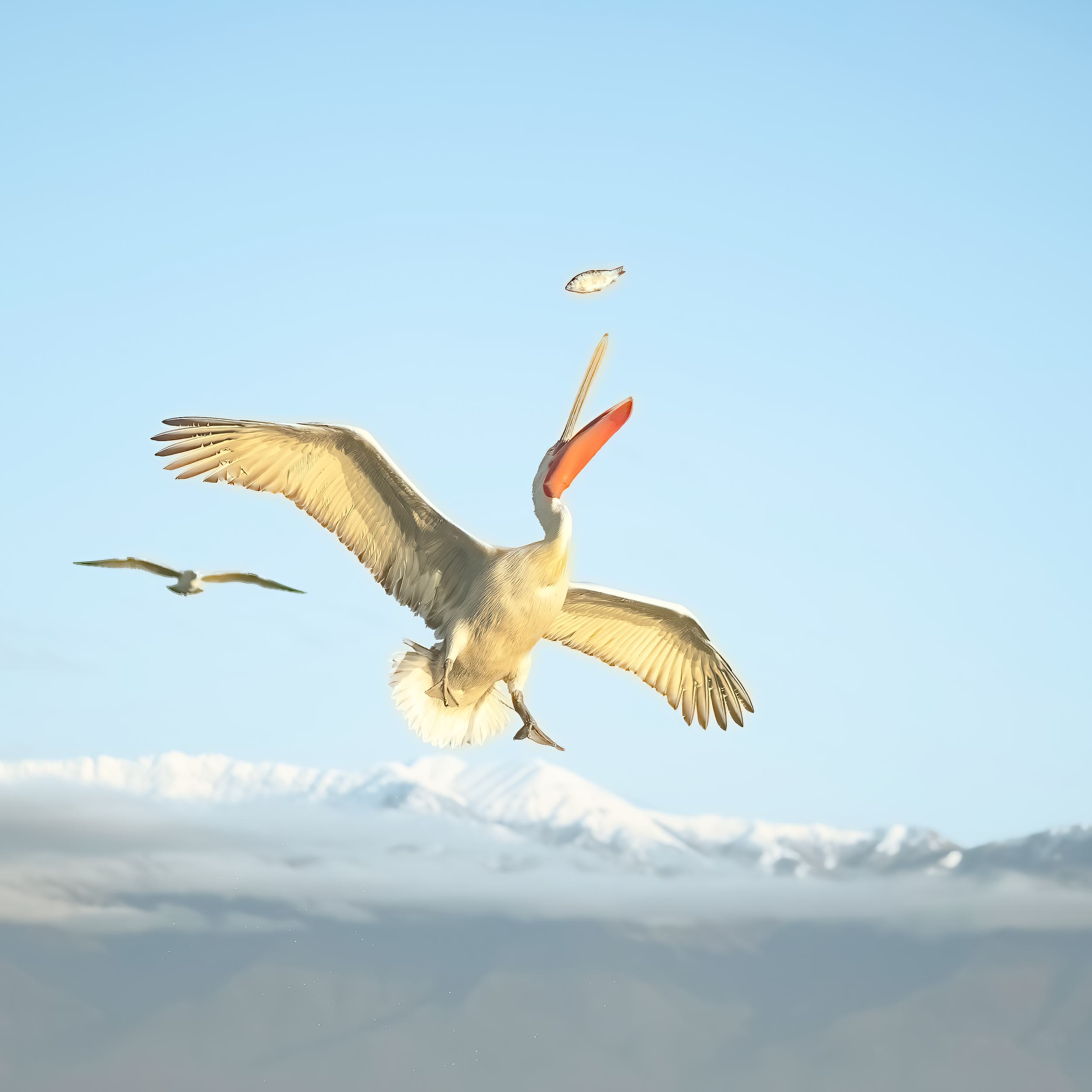
Dalmatian Pelican
The Photography Experience
Knowing the facts is one thing. Photographing pelicans from a rustic wooden fishing boat on Lake Kerkini is something entirely different. What makes Lake Kerkini remarkable for photography is proximity. The pelicans are accustomed to the presence of boats. They feed, loaf, preen, jump aboard, and run across the surface before lifting into flight — offering constant opportunities to photograph behavior and portraits.
The first morning out on Lake Kerkini set the tone for the week. It was windy, the water a bit rough, and the temperature in the 20s. We were bundled up on a small wooden boat at dawn’s first light — not the flat, pink conditions we had hoped for.
And then I saw my first Dalmatian Pelican.
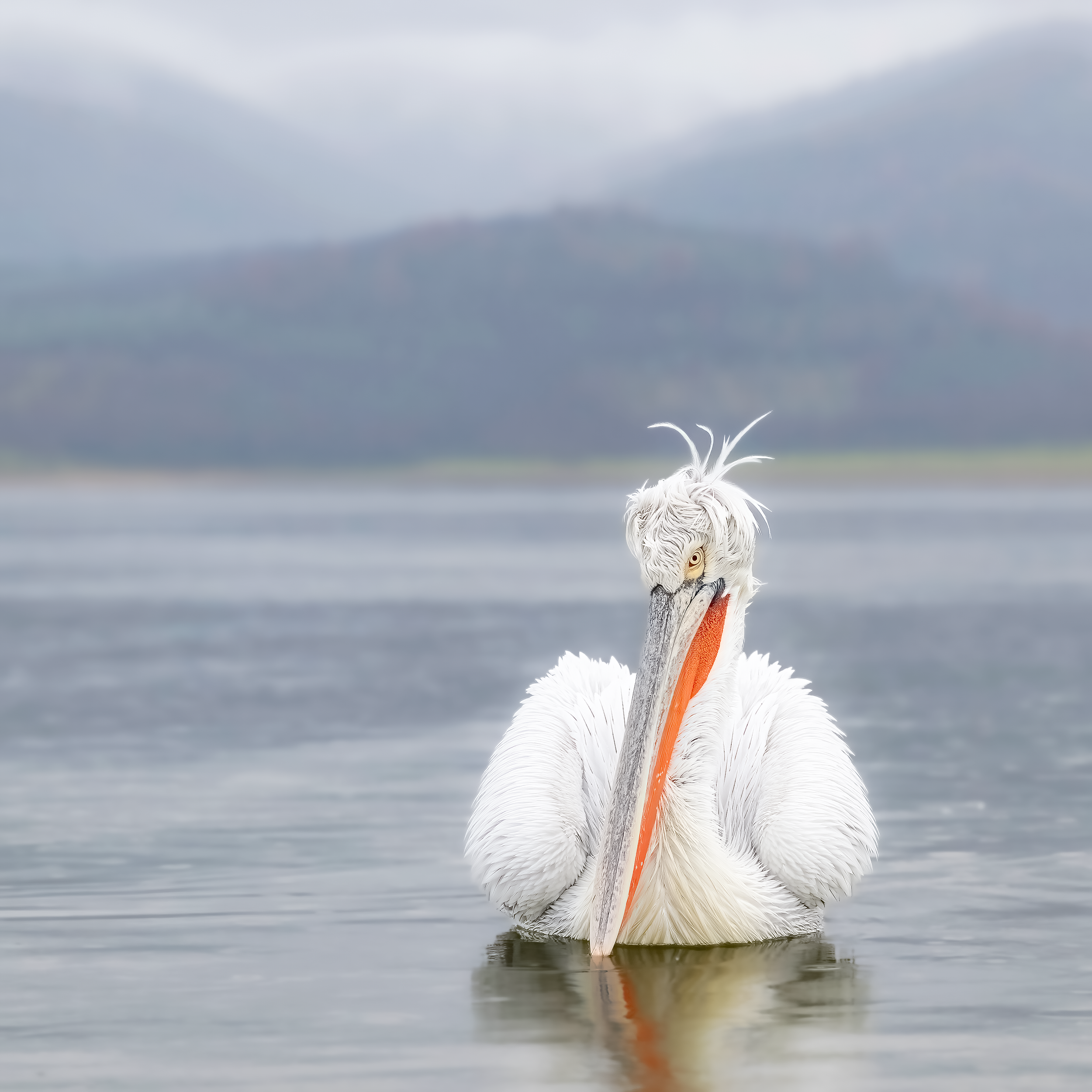
Dalmatian Pelican
It was almost cliché in its impact. It took my breath away. I stood there thinking, I cannot believe I am here — more than 5,000 miles from home — on this small wooden boat in winter wind, watching these pelicans circle us waiting for fish.
They looked soulful, yet slightly comical with that mop of feathers on their heads. So large. Their wingbeats slow and deliberate. So graceful as they flew in and ran across the surface before lifting into the air.
Most of the week unfolded in shades of gray — fog, drizzle, snowfall, and a few blue-sky days without pastel color — but that first morning was not about light, it was about orienting oneself to being in the presence of these magnificent birds.
From the Shore: Snowfall and Pinky the Great White Pelican
We also photographed the pelicans from shore. In a small sandy cove on Lake Kerkini, we lay flat and worked at eye level as snow fell steadily. The muted light and fresh snowfall softened the scene. It was ideal for wide-angle work — pelicans close, landscape included.
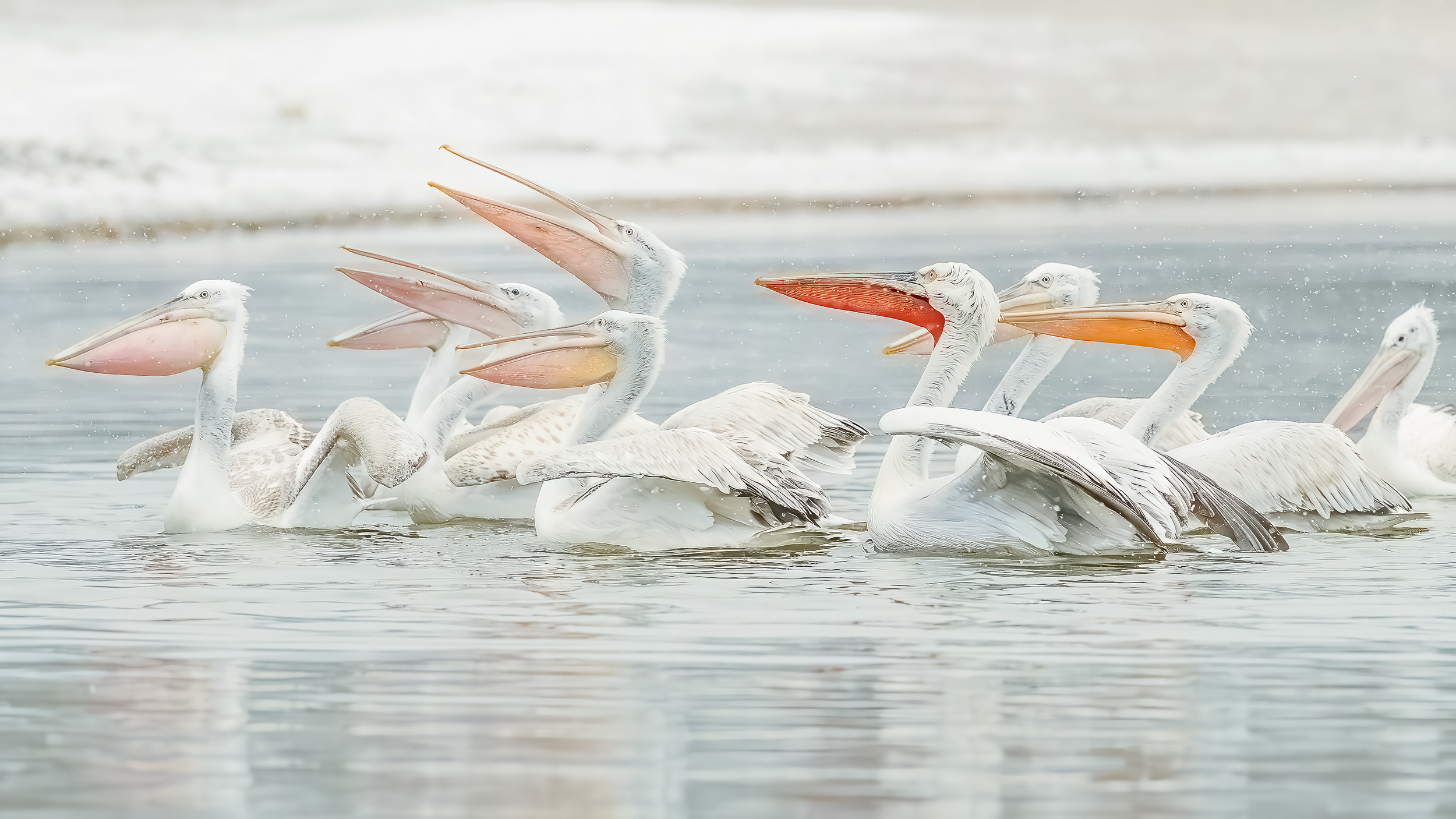
Dalmatian Pelicans
One environmental image in particular stayed with me: a juvenile Dalmatian Pelican drifting past the opposite shoreline as snowflakes fell. Behind it, a dirt road wound up the hillside, white with fresh snowfall. Olive trees stood adjacent to the road, and above them sat a small white Greek chapel. The scene caught my attention immediately. I pre-visualized a pelican drifting in front of it and waited.
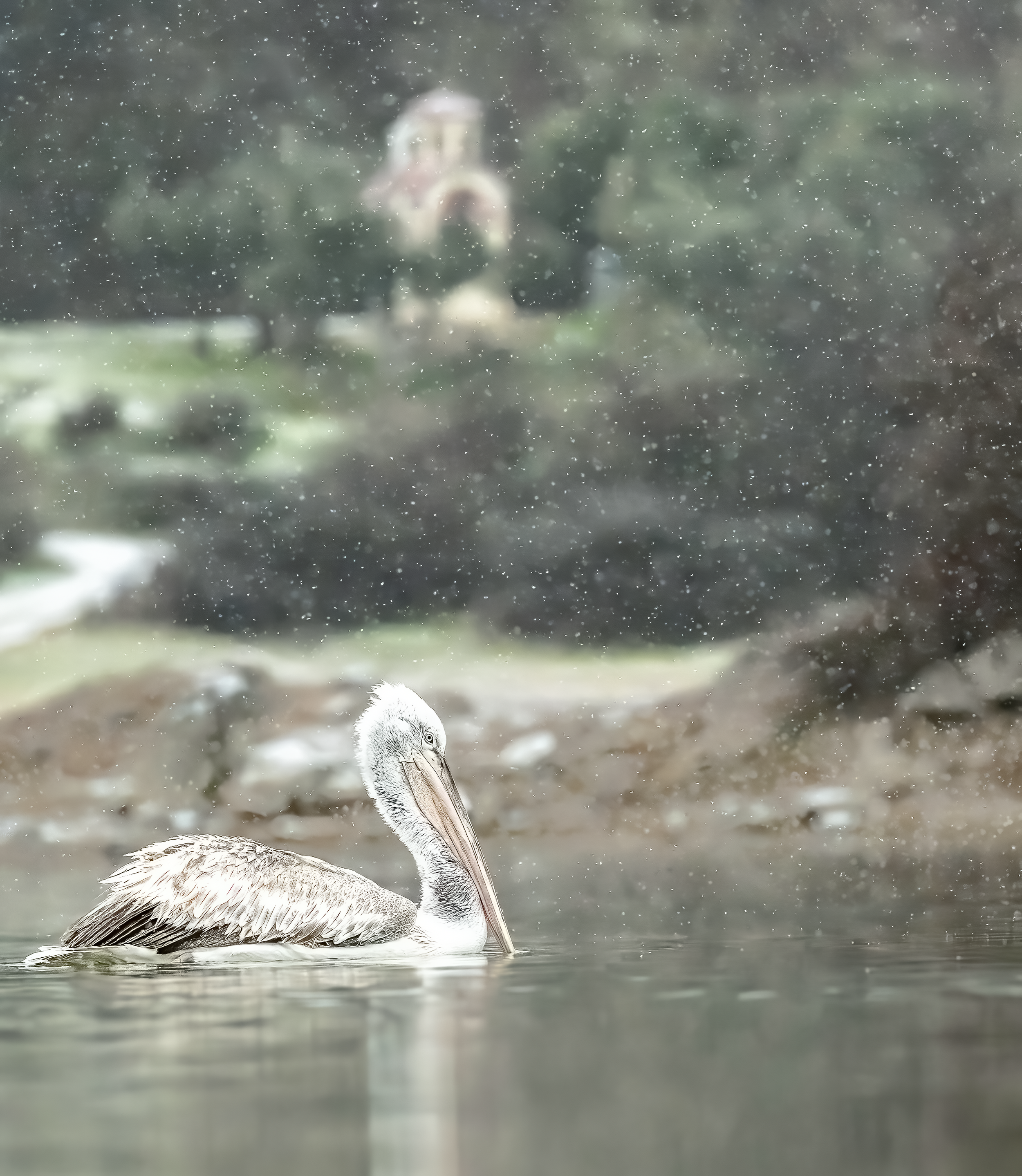
Juvenile Dalmatian Pelican
Through the lens in that cove I also saw Black-headed Gull, Pygmy Cormorant, Great Crested Grebe, and Grey Heron and a pair of White-tailed Eagles flew across the lake.
Then a rare, unexpected visitor appeared: a single Great White Pelican — “Pinky.” Its plumage was a light pink, the bill pale yellow. It swam in and floated among the Dalmatian Pelicans.
Great White Pelicans congregate in huge numbers in the Danube River Delta — more than half of Great White Pelicans are reported to breed there. After breeding season, they move south. The guides see them arrive at Lake Kerkini during migration — as a stopover point, often so tired they seem to simply drop down onto the lake, settle on the water, and rest before moving on. That’s exactly what a good wetland stopover is for: a place to put down, recover, and feed. The presence of Pinky in winter here is likely due to suitable feeding conditions and open water that allow some Great White Pelicans to overwinter rather than continue south.
And the pink? Great White Pelicans can show a soft pink flush, especially when they are in breeding condition in spring and summer. The blush is caused by carotenoid pigments in their diet and seasonal hormonal changes that intensify bare skin coloration. Even outside peak breeding, a faint wash of pink can remain visible, particularly in good light, like the kind we had today in the snow.
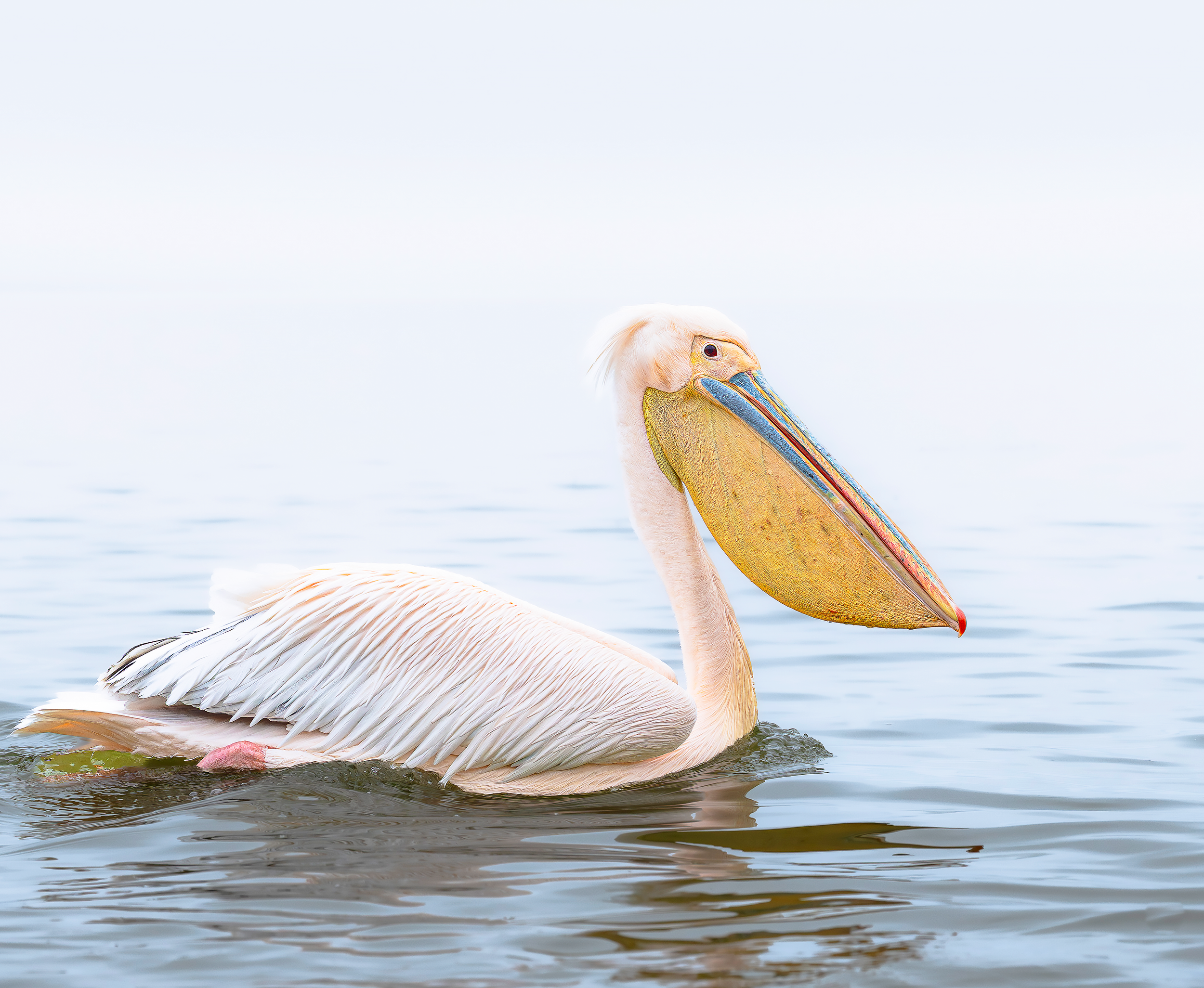
Great White Pelican
Photographing Pelicans: Water and Movement
Much of our time on Lake Kerkini was spent working movement.
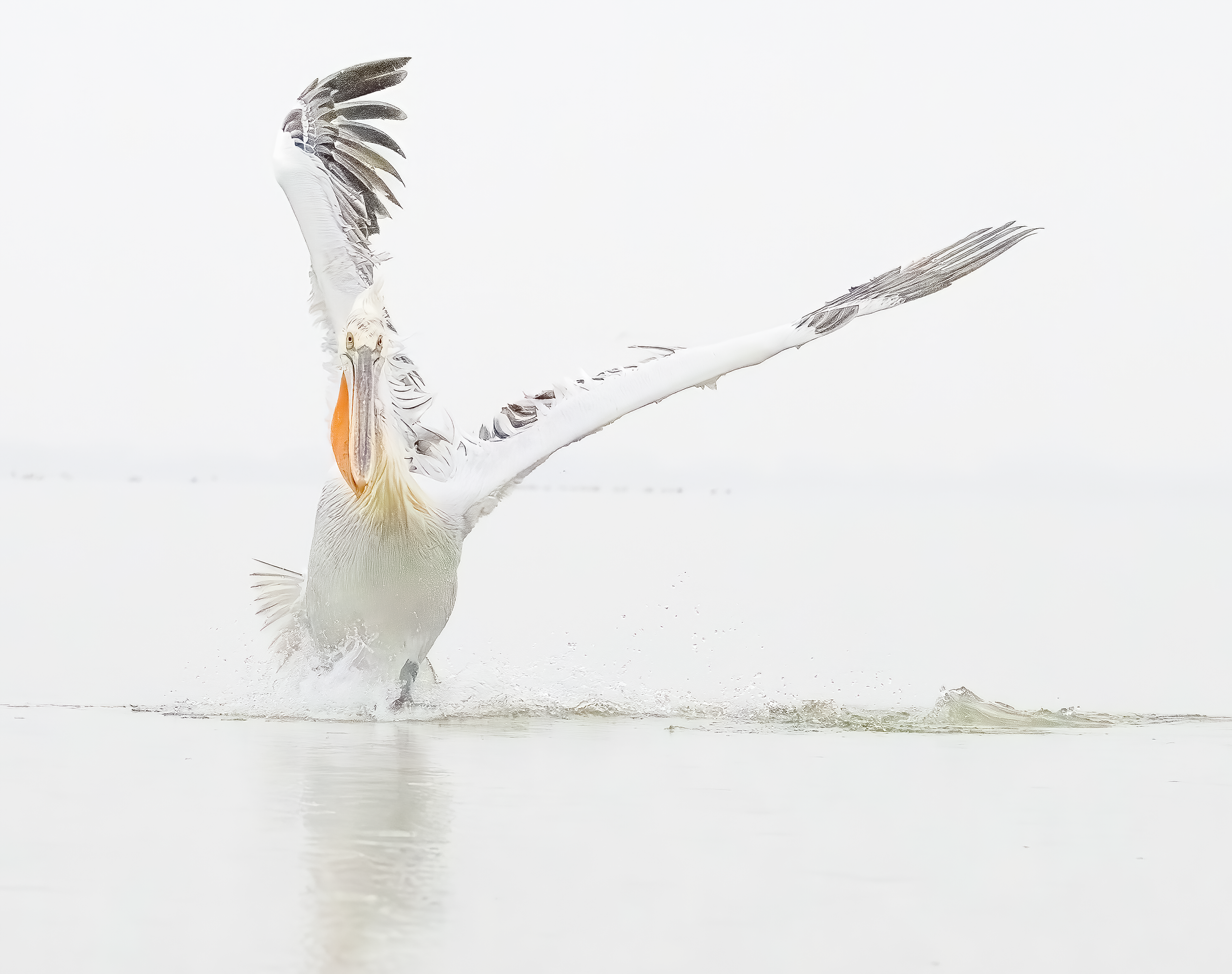
The guides would throw fish and position the boat so the pelicans approached into the best light and against clean backgrounds — snow-covered mountain peaks under blue sky, or gentle fog laying over the hillsides. As the pelicans sprinted across the water and lifted into the air, we practiced panning — following the bird through the frame to capture blurred wings with a sharp eye. There were constant opportunities to refine the technique.
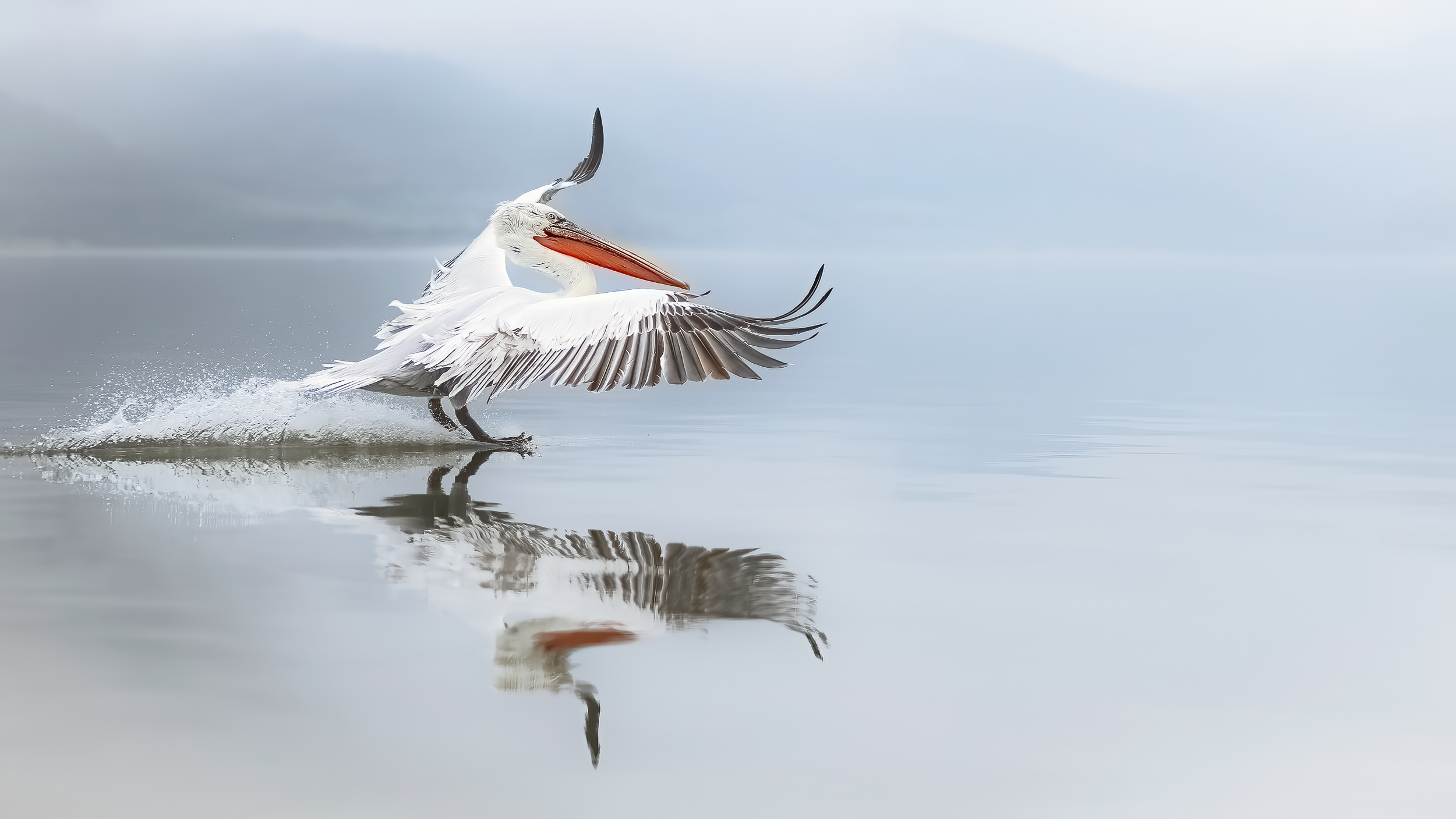
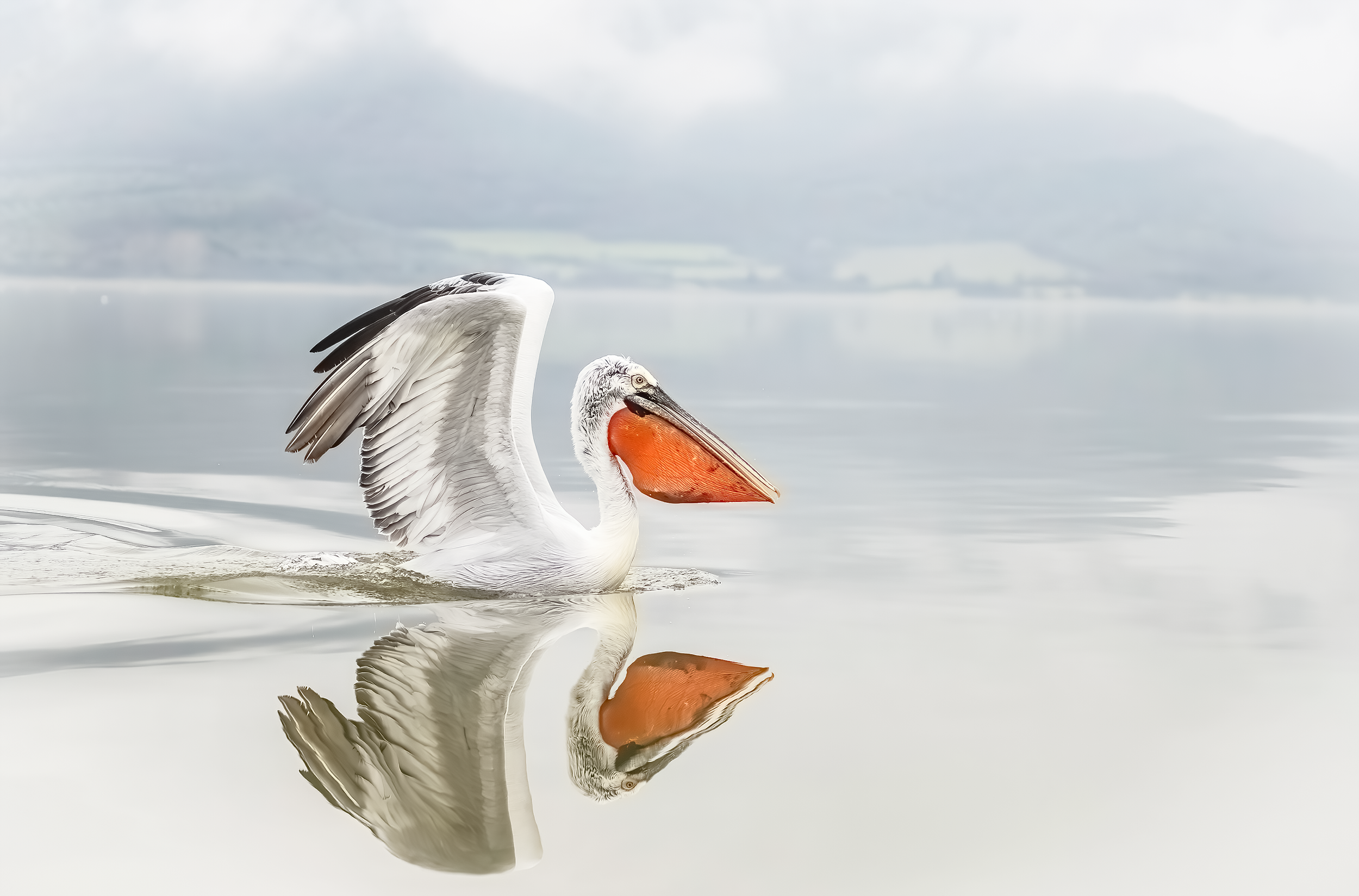
I primarily used a 400mm prime lens for these sequences. The reach allowed isolation of landings, splash patterns, and birds flying straight into the lens. At times the pelicans came so close that I switched to a 70–200mm and even a 50mm prime lens to accommodate the proximity.
Other creative opportunities included high-key images, low-level reflection and blur motion shots. There were constant opportunities for portraits at eye level from the boat. The guides instructed us to lean carefully over the side so the lens sat just above the water’s surface. Using the viewfinder, we photographed pelicans floating and resting. These images worked best on flat water and with a wide-angle lens.
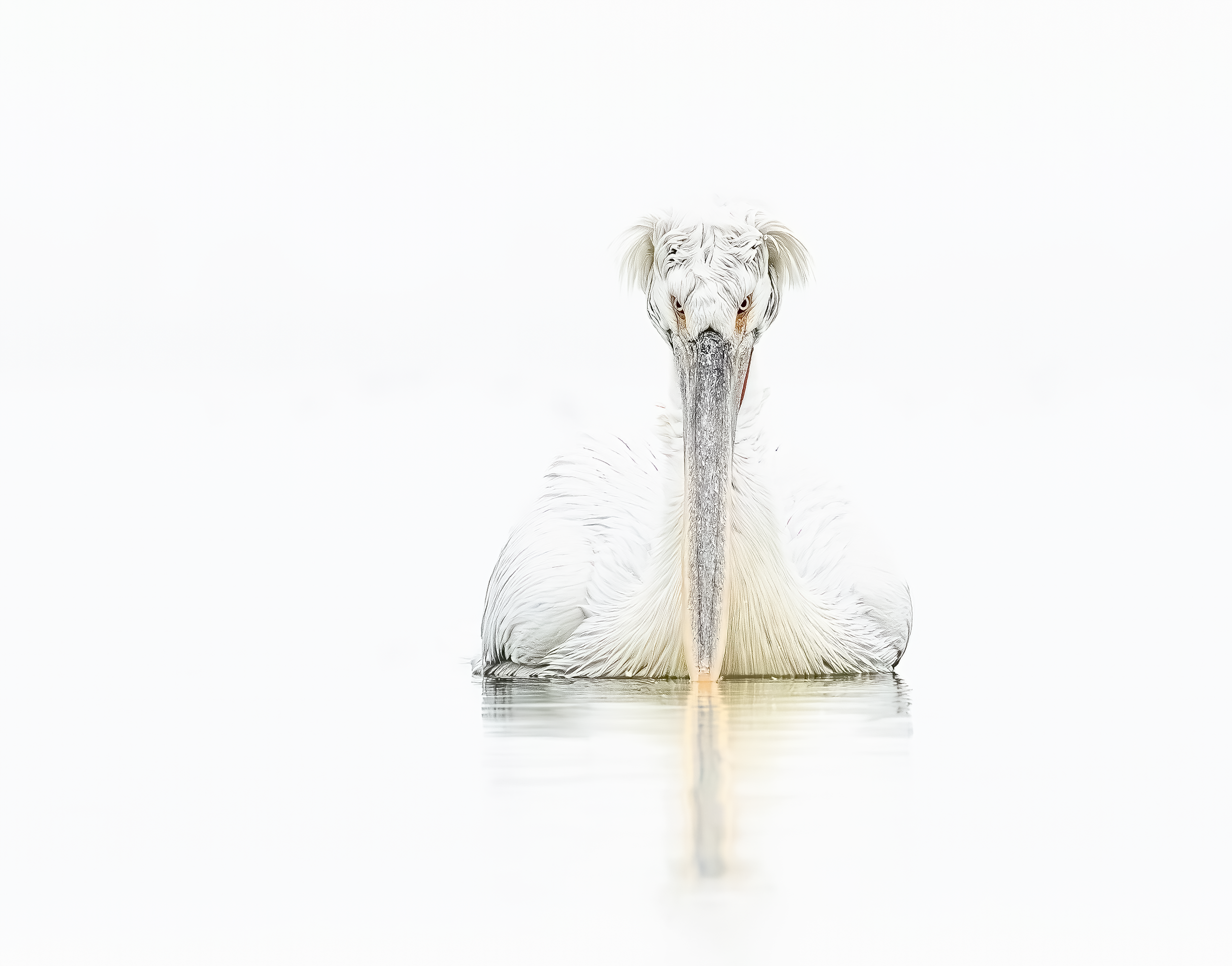
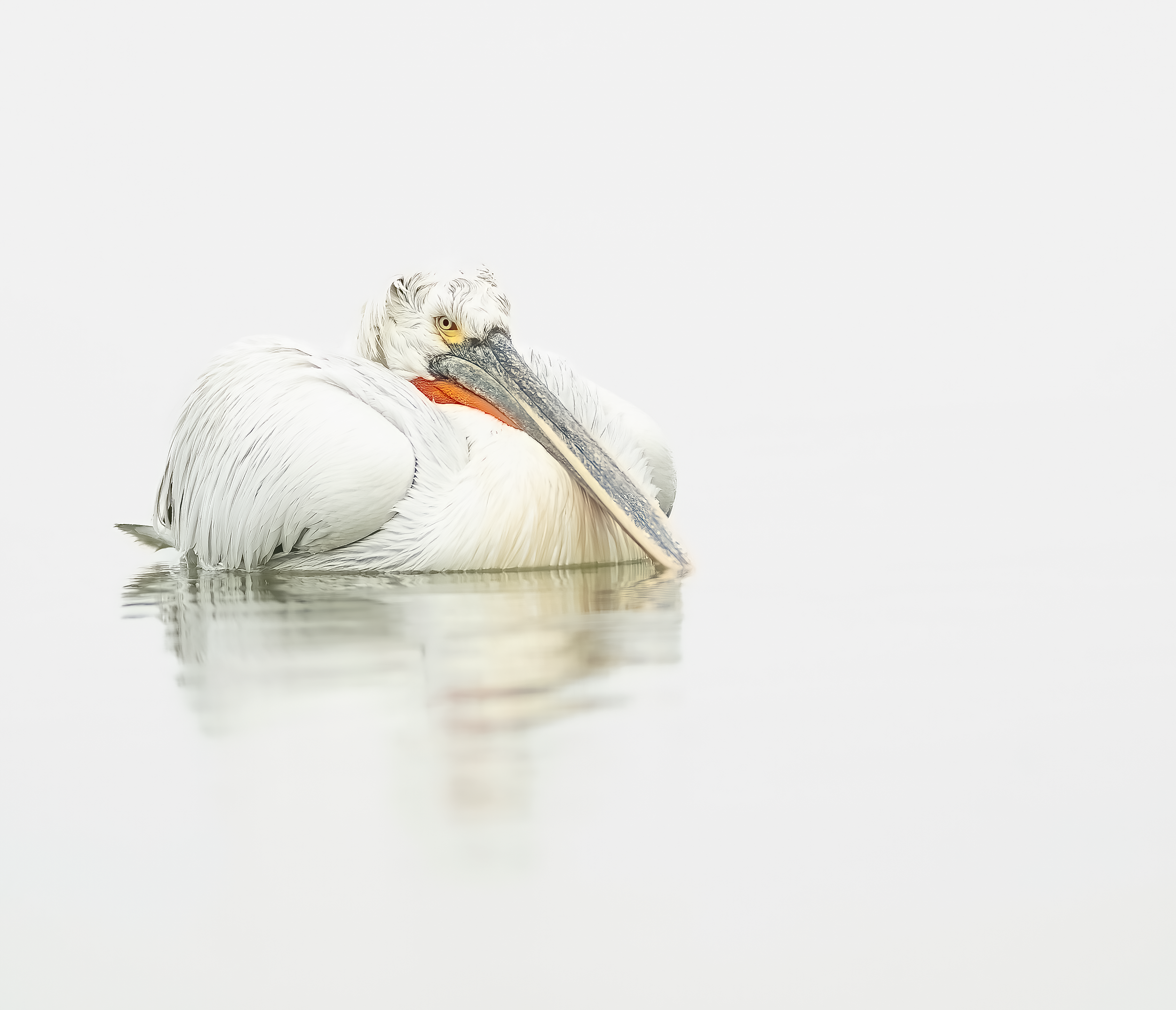
One afternoon we motored to the far side of Lake Kerkini, where the green marsh grass marked the edge of the wetlands. The background was clean and simple, shifting to a vibrant green against the water. The pelicans were still — floating quietly. In the distance, we could hear the calls of Common Crane, though they were not visible, somewhere deeper in the marsh.
This is also the area where the Dalmatian Pelican roost. Occasionally we would see a formation of pelicans flying low on the horizon in for the night. We stayed until sunset, and the boat ride back was in the dark.
Lake Kerkini is far more than a pelican destination. While the Dalmatian Pelicans commanded attention, the lake proved to be a prolific birding site. I observed Little Egret, Grey Heron, Eurasian Coot, flocks of Common Starling, and Eurasian Magpie along the agricultural edges. Three species of grebes — Great Crested Grebe, Little Grebe, and Black-necked Grebe — were present on the water, along with Pygmy Cormorant and Black-headed Gull.
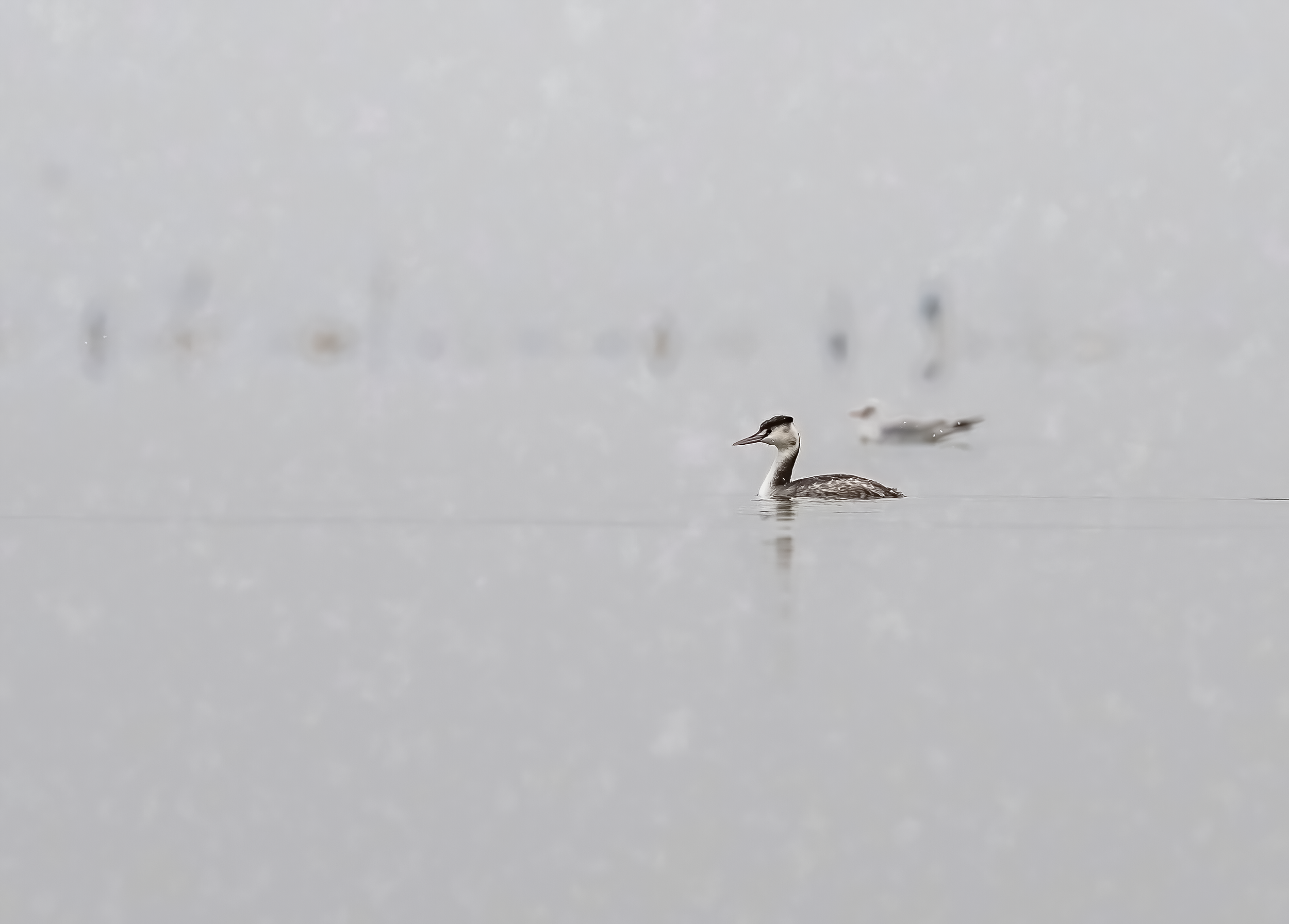
Great Crested Grebe
From action sequences to quiet portraits, Lake Kerkini offered space to experiment — and to observe.
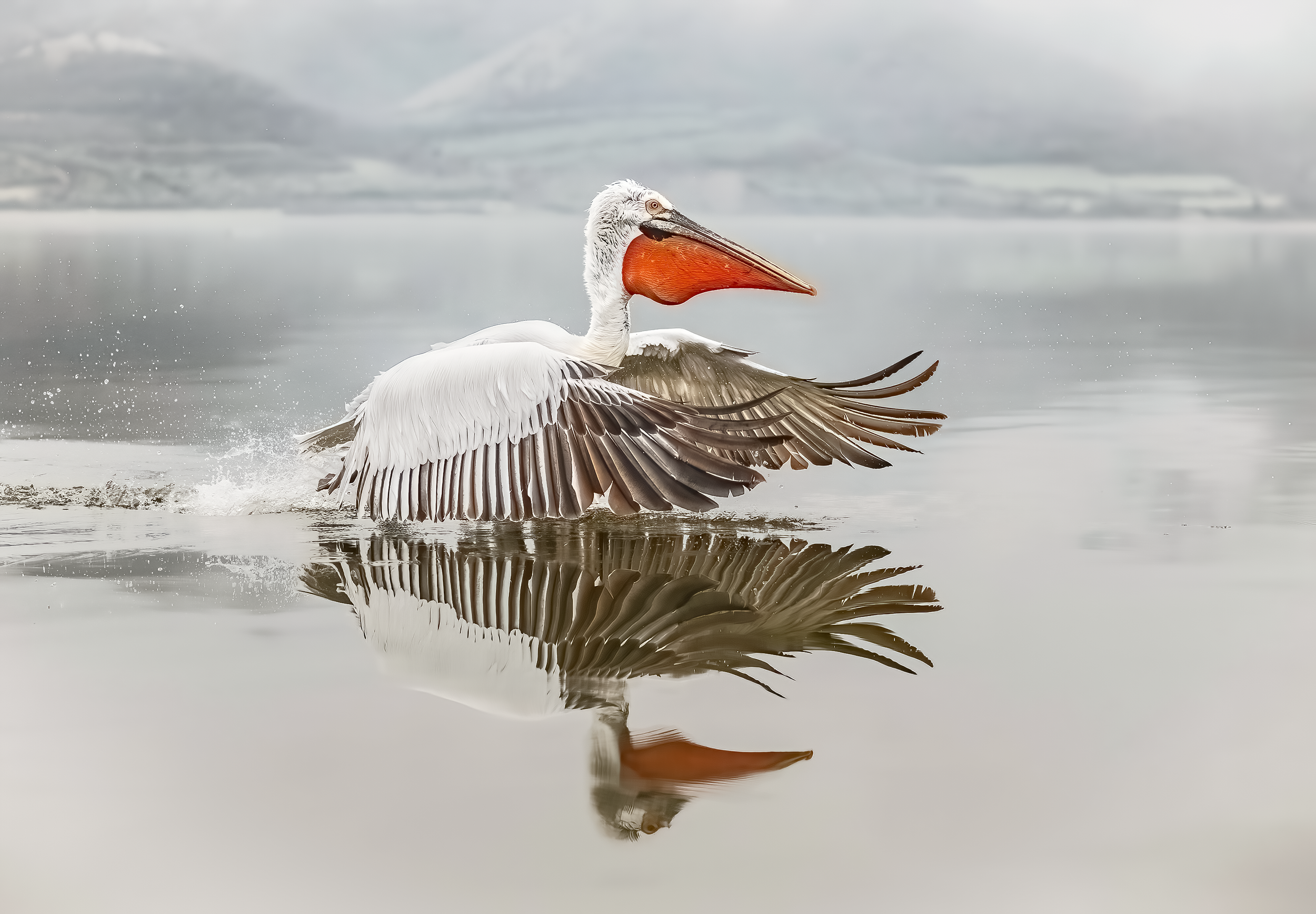
Dalmatian Pelican
On the southern edge of the Balkans, in a working rural landscape shaped by river and history, Lake Kerkini now shelters pelicans of remarkable scale and presence. To stand in that setting — mountains near the Bulgarian border, wetlands alive with winter sound — and photograph these birds at eye level was a privilege. It is a place where geography, culture, and wildlife intersect, and where four cold January days felt deeply meaningful.
Read the blog post in this two-part series: Great Flamingos in the Kalochori Wetlands