
Read the Bird: Don't Fight the Flock. How to Compose Bird Photos That Tell a Story
This post is part of Read the Bird: Field Notes on Bird Photography — an ongoing series on bird photography in the field. Real situations, real light, real challenges. Each installment focuses on a specific compositional or technical problem and how I work through it. Whether you're shooting with a smartphone or a professional camera, these are approaches you can put to use the next time you're out. More posts in the series to come.
Photographing mixed flocks — seabirds, shorebirds, or any gathering of birds — makes clean composition a challenge. In the image below, a Black Skimmer and a Laughing Gull share a strip of sunrise beach — two different birds, two different body shapes, moving on their own schedules. One approach I use: don't fight the flock — work within it. I look for a moment when one bird separates slightly, just enough to give it space in the frame. Then I position it with a clean background and wait for a natural gesture — wings up, skimming low, or a glance that adds interest. You don't need isolation. You need just enough separation.

Black Skimmer and Laughing Gull
None of what follows is about camera gear. These ideas apply whether you're shooting with a smartphone, a point-and-shoot, or a professional telephoto lens. Composition is about how you see and when you decide to capture — and those are skills that live in the photographer, not the equipment.
That morning I watched these two for a while before I pressed the shutter. The Skimmer was low and horizontal, bill forward, tail fanned. The Laughing Gull was upright and in mid-stride, head tilted up and beak slightly open. Neither bird was doing anything dramatic. But together, at that exact second, they were doing something true
The Moment Doesn't Announce Itself
Henri Cartier-Bresson called it the decisive moment — the fraction of a second when form and feeling align perfectly in a single frame. People quote him often in photography circles. Fewer people actually think hard about what it means for birds.
👉 Cartier-Bresson wrote about this at length in "Henri Cartier-Bresson: The Mind's Eye" worth a read if you haven’t.
It doesn't mean waiting for the big action shot. It means recognizing when a bird's posture, position, and gesture combine to say something — and it starts long before you press the shutter.
My favorite image from this year shows exactly what I mean. I had positioned myself on the beach before sunrise, facing east, waiting for the sun to break the horizon over the Atlantic. I knew the light would be extraordinary for a few minutes and I wanted shorebirds in that frame. I could see a group of Marbled Godwits feeding to my left, and I watched their behavior long enough to make an educated guess: they were moving in my direction. So I waited. I let them come to me.
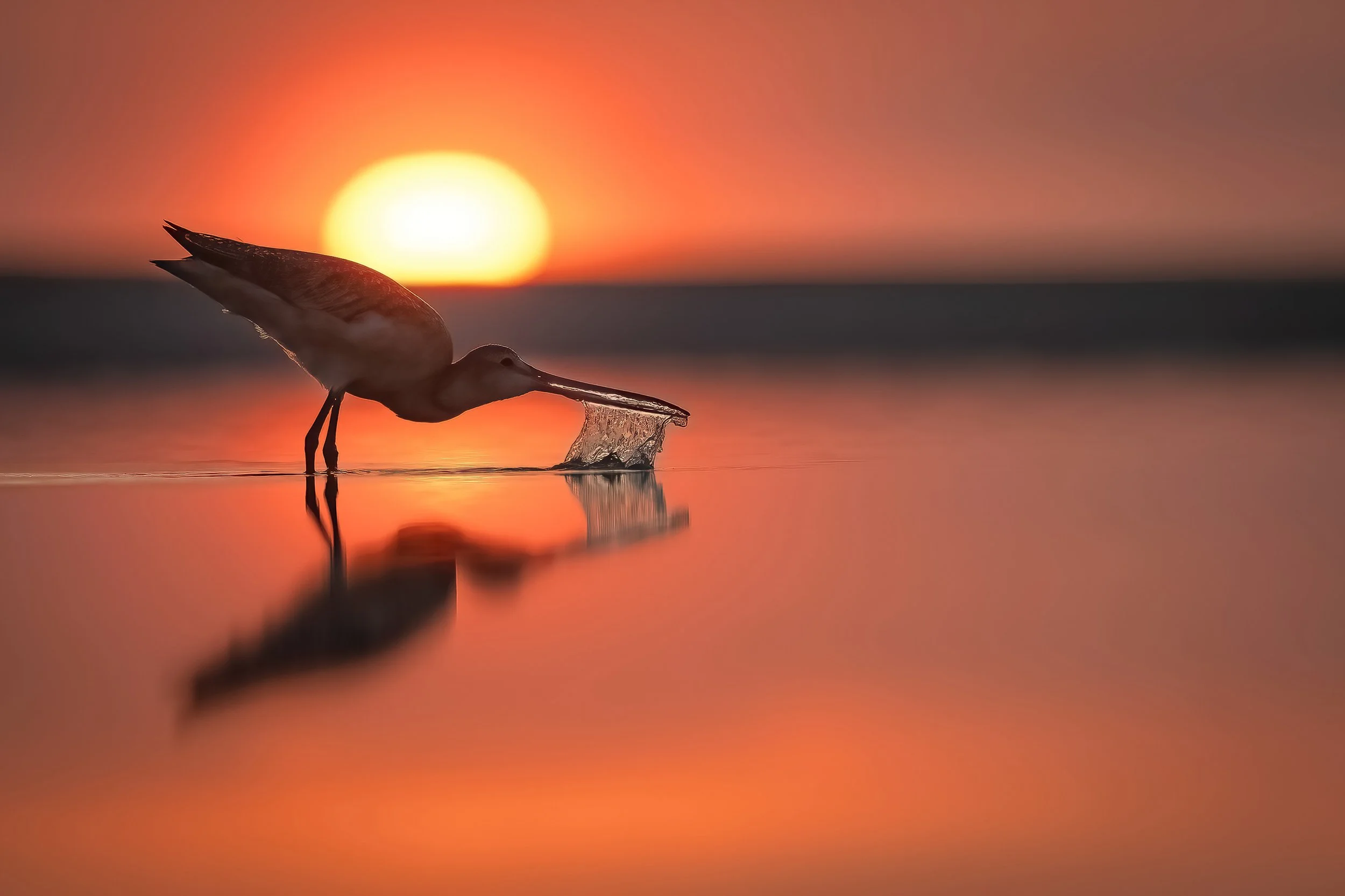
Marbled Godwit
When the Godwit entered the frame, the bill was breaking the surface and the water was lifting in a curtain of reflected orange light — the sun directly behind the bird, the whole world burning warm. A half-second earlier, that water isn't moving. A half-second later, it has already fallen back. The image exists in the fraction between those two moments.
But the water isn't the only thing making it work. The wing is raised — not fully extended, just lifted slightly off the body. That one detail turns the bird's silhouette from a simple feeding arc into a diagonal that pulls your eye from the upper left straight down to the splash. Remove the wing lift and you have a good photograph. With it, you have the photograph.
That's the deeper truth of the decisive moment: it isn't just reaction. It's anticipation. You read the light, you read the birds, you put yourself in the right place, and then you wait for the moment to arrive. Cartier-Bresson wasn't just fast. He was positioned.
And here's the thing — that approach costs nothing. No lens upgrade required. Positioning yourself before sunrise, watching bird behavior, making an educated guess about where they're headed: that's available to anyone standing on a beach with any camera in their hand.
It's quieter in the Skimmer and Gull image, but the same principle holds. What says it there is the Laughing Gull's upward glance — the head tilted back, looking at something we'll never see. That look carries the whole frame. Without it, you have two birds standing on wet sand. With it, you have a moment: something that was happening in the world that morning, and now won't stop happening inside the photograph.
Gesture Is the Difference Between a Portrait and a Story
A raised foot changes everything. I mean that literally. A bird standing flat on two feet looks planted, at rest, static. A bird balanced on one leg, mid-stride or in mid-weight-shift, looks like it's going somewhere, thinking something, about to do something. The mood of the image shifts entirely. And you don't need a fast shutter speed to catch this — a bird mid-stride holds that position for a breath. Your smartphone can capture it if you're watching for it.
Head angle works the same way. A bird looking straight at the camera is a portrait — confrontational, aware of the photographer, slightly formal. A bird looking off-frame is in its own world. You're watching it, not posing it. That's the feeling most of us are after when we go out before sunrise and wade into the edge of the marsh.
But the most complete gesture is when the whole body commits. A White Ibis in breeding color (bright red beak and legs), foraging in a still marsh pool — that image shows what I mean. The head is curved down, neck fully extended, bill angled into the water. The back feathers are ruffled and lifted with the effort. One legs is planted firmly in the mud, while the other is raised and dripping in mud. Nothing in that bird is neutral. Every part of it is in the same moment, doing the same thing. You don't need to know what a White Ibis is to understand that this bird is hunting, and that it is completely focused on what it's doing. The reflection in the water below doubles the gesture — you get two reads of the same arc, and the image holds you longer for it.
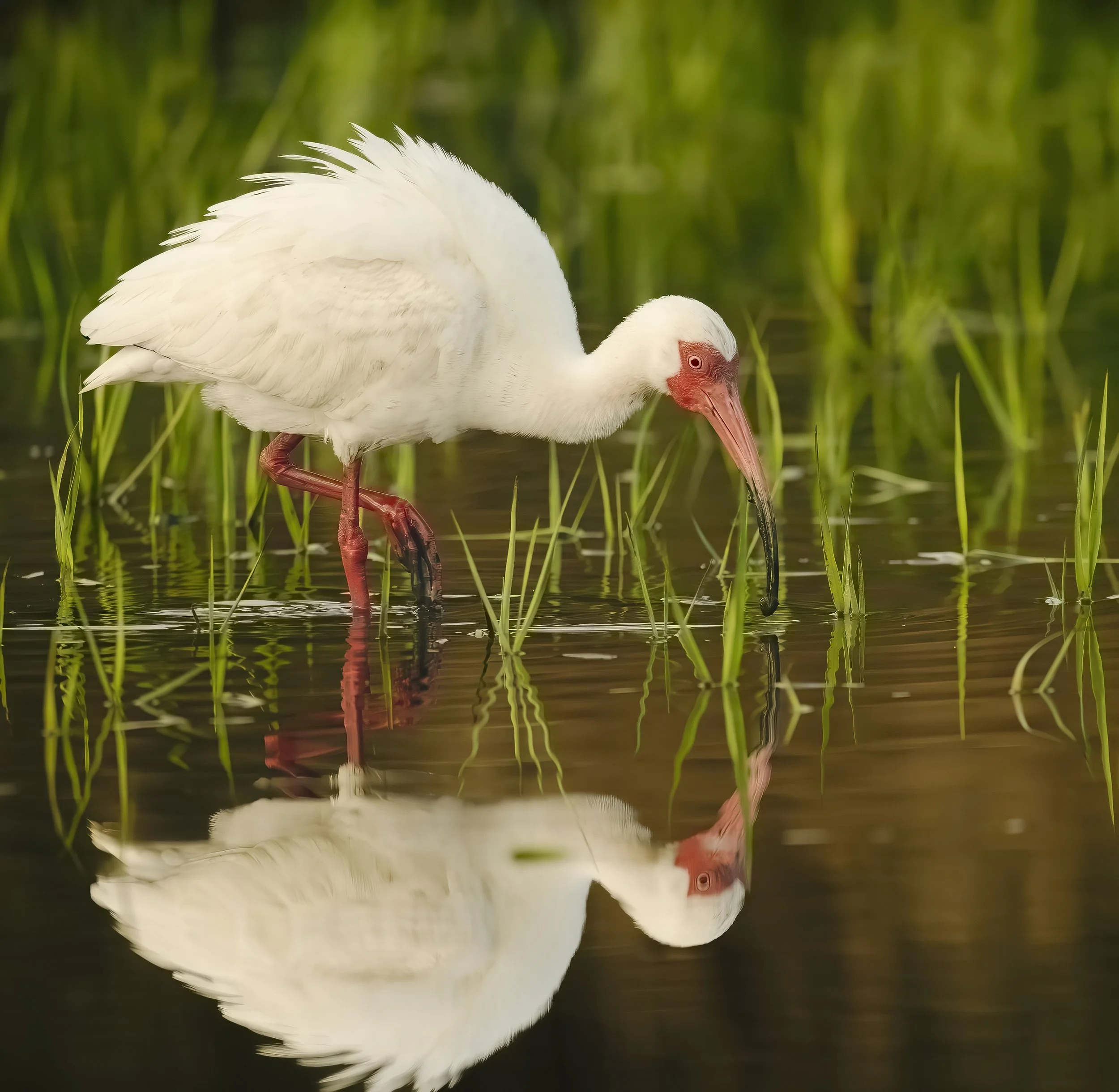
White Ibis
That's what gesture does when it's total: it removes the photographer from the equation. You're not there. You're just watching something that was already happening.
In the Skimmer and Gull image, the gesture is quieter but it still works. The Skimmer is low and horizontal — practically parallel to the waterline. The Gull is upright. The opposition of those body shapes creates tension that isn't dramatic but is interesting. One bird at rest, one bird in motion's pause. You don't have to manufacture those contrasts. You just have to recognize them and not interrupt them.
👉The Art of Bird Photography by Arthur Morris - essential reading for understanding how behavior and composition work together.
The Bird Doesn't Have to Fill the Frame
There's a concept in Japanese garden design called shakkei — borrowed scenery. The idea is that what lies beyond the garden wall can be incorporated into the composition, so the space feels larger than it is. The mountain in the distance becomes part of the garden. The landscape is borrowed.
👉 Wabi-Sabi for Artists, Designers, Poets & Philosophers by Leonard Koren, unexpected but genuinely relevant to the Japanese aesthetic concept.
👉Read my blog post: Wabi-sabi and Lowcountry Bird Photography
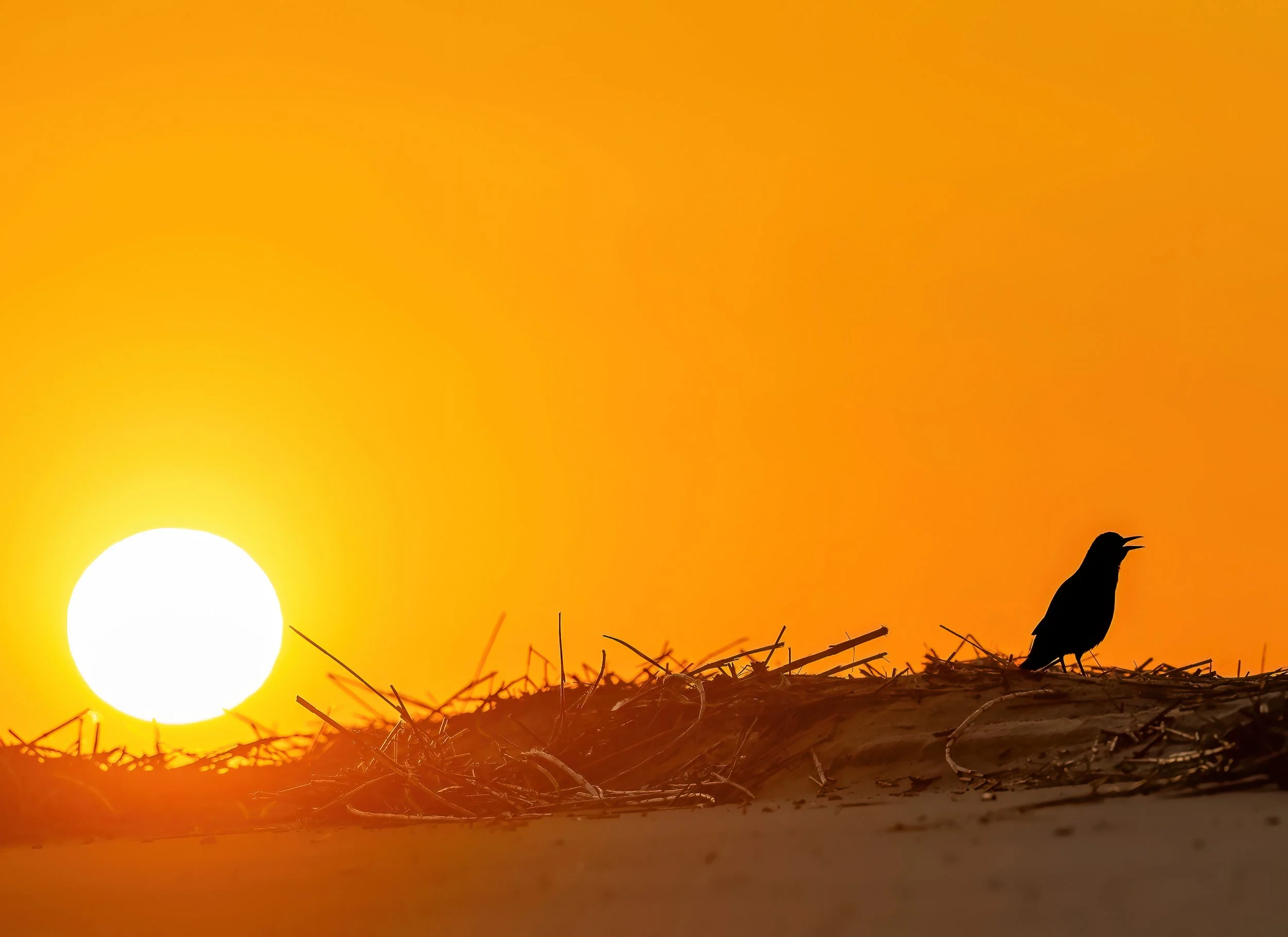
Bird photography works exactly this way when you let it. Two images I keep coming back to show this as a spectrum. In one, a Boat-tailed Grackle is silhouetted on a mound of driftwood, beak open, singing directly into a rising sun that fills the left side of the frame. The bird is small but it has presence — a pure black shape against fire orange, balanced against that enormous white disc. The landscape is borrowed, but the bird holds its own within it.
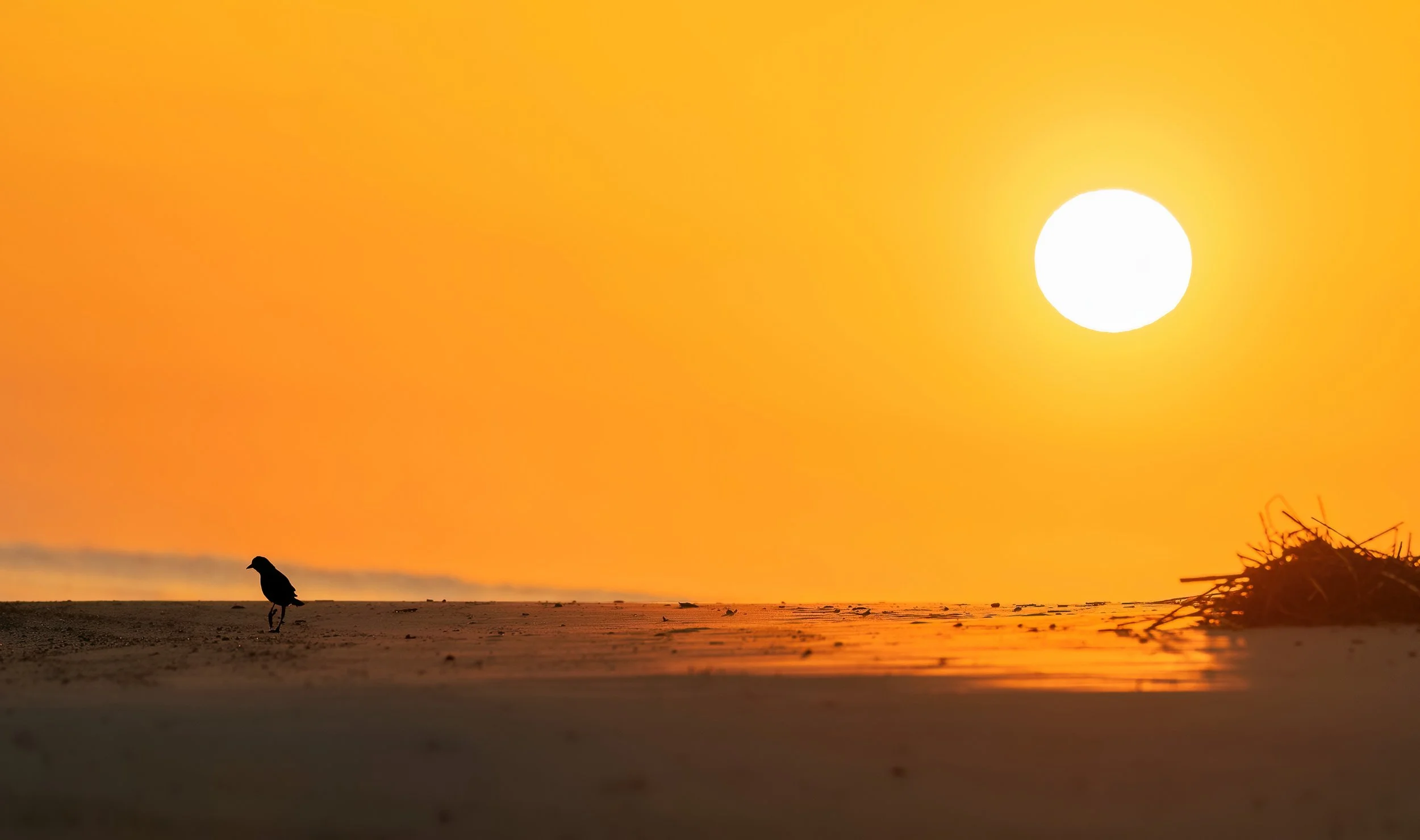
In the other image, taken on the same beach in the same light, the Grackle is tiny — a small dark figure striding across the lower left corner of the frame while the sun sits enormous in the upper right and the whole world is orange. The bird is almost incidental. Almost. It's still the reason you're looking.
Those two images sit at opposite ends of the same idea. In both, the sky is doing most of the work. In both, the bird earns its place not by filling the frame but by being exactly where it is — one singing into the light, one walking through it. The environment isn't background noise. It's a co-subject.
The same is true of the Skimmer and Gull image. That warm golden sky was occupying the top half of the frame. I didn't crop in too tight. I let them be true to size in it. That choice is counterintuitive — we're taught to fill the frame, to get close, to make the subject large. But sometimes the most powerful image is the bird as a small note in a larger visual poem. I borrowed the sky.
Leave the Bird Room to Fly
When a bird is in flight, the eye follows its line of motion. This is involuntary — it's how we're wired to track moving things. So when you cut off the space in front of a flying bird, you've created visual tension that fights the natural reading of the image. The eye tries to follow the trajectory and runs into the frame edge. It's uncomfortable in a way that works against you.
A Limpkin in flight over Lake Kissimmee shows the principle clearly. The bird is in the left-center of the frame, wings fully extended, feet trailing, traveling right. The bill, the eye, the whole line of the body points into open blue sky. There's room to go. You follow it naturally, without resistance.
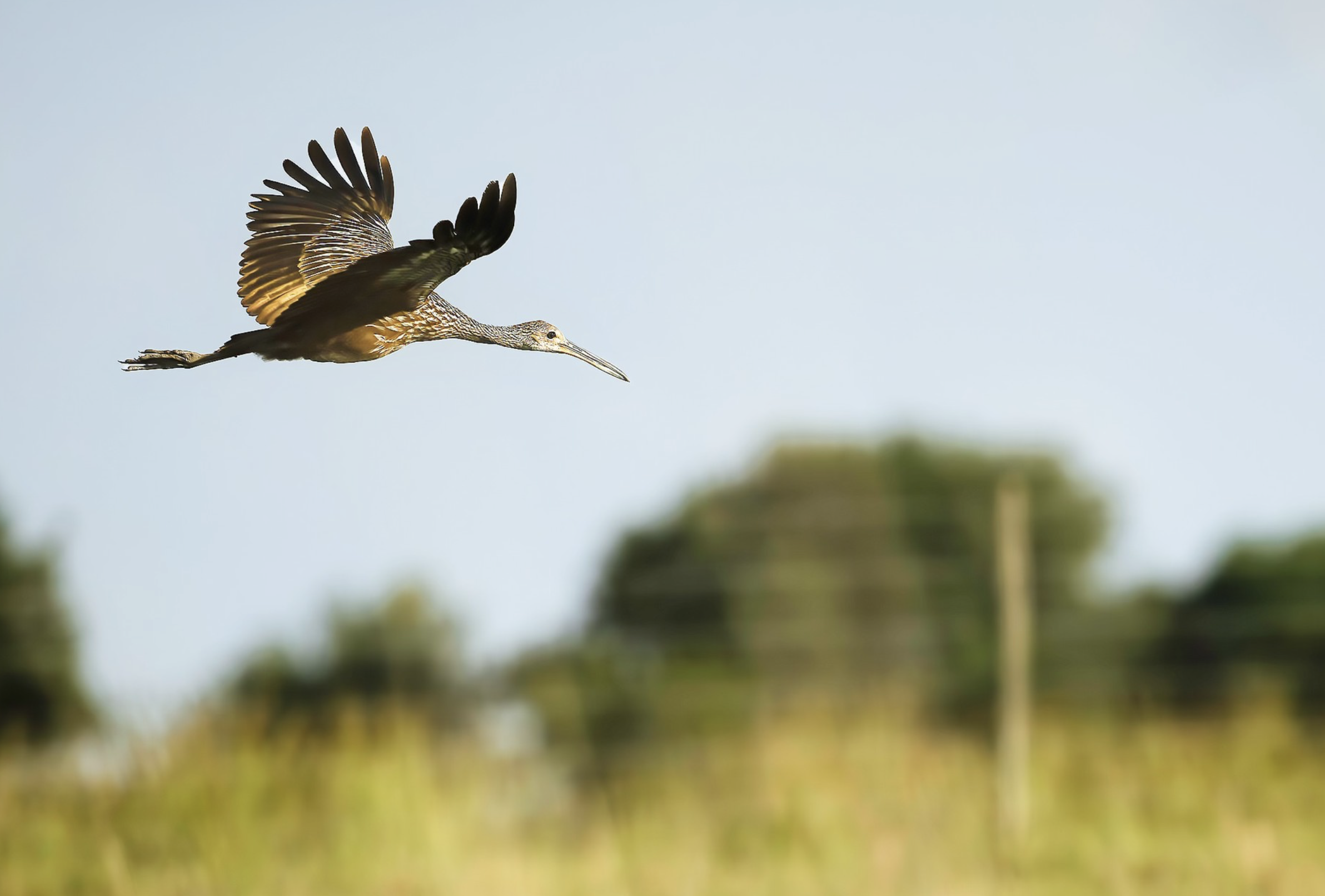
Limpkin
The lower background isn't clean — a blurred treeline and a fence post sit behind and below. Field conditions rarely are. But notice that the imperfect background doesn't undermine the image, because the negative space in front of the bird is doing its job. Leading space is the priority in flight shots. Get that right and the image reads, even when everything else isn't perfect.
The fix is straightforward: leave room in the direction of travel. If the bird is banking left, more space on the left. If it's heading into the frame from the right, give it somewhere to go. The open space in front of the bird isn't empty — it's active. It's where the motion is headed. It matters as much as the bird itself.
Don't Fight the Flock
Don't fight the flock. Work within it.
When there are hundreds of Black Skimmers and Laughing Gulls and a Willet wandering through a scene, the instinct is to wait until the frame clears — until one bird steps away from the others and you get your clean isolate. Sometimes that happens. More often, you wait and the tide changes and the light is gone.
What I do instead is watch for the micro-moment of separation. One bird takes a half-step to the right. There's now a sliver of air between it and the others. The background behind it has opened up, even slightly. In that sliver, you can find your image. Not a clean studio shot — something more honest than that. Something that shows the bird in its actual context, surrounded by the noise and movement of its world, but readable. Present.
That separation doesn't last. A second later the flock has shuffled and the moment is gone. But it was there.
Background Is a Decision, Not an Afterthought
One of the most useful things you can do before you press the shutter is look past the bird. What's behind it? Is the background helping or competing?
A female Boat-tailed Grackle bathing in a tidal pool on an overcast morning — that image is almost entirely white. The sky reflected in the water has dissolved into near-nothing. The bird sits in the upper third of the frame, wet and ruffled mid-bath, one wing tucked, eye sharp and direct. There's a second Grackle behind her — visible, but soft. Out of focus, blurred into warm tone, placed just far enough back that it reads as atmosphere rather than distraction.
That second bird could have wrecked the image. It didn't, because of two things: the low shooting angle, which used the overcast light reflecting off the water to dissolve the background, and the separation between the two birds — just enough that the focal plane kept the subject sharp and let everything else fall away. The background isn't blank. It's just quiet.

Female Boat-tailed Grackle
This is worth thinking about before you move. Changing your angle by a few feet — lower, higher, a step left — can completely change what's behind your subject. The bird may not move. Your position can. And sometimes the difference between a cluttered frame and a clean one is simply where you're standing. That's a tool every photographer has, regardless of what's in their bag.
Composition Is a Practice of Attention
All of these concepts — the decisive moment, gesture, borrowed scenery, negative space, working the flock, reading the background — they're techniques, sure. But more than that, they're habits of looking. They're what happens when you slow down enough to actually see what's in front of you before you reach for the shutter.
None of them require a particular camera. They require attention. A beginning photographer with a smartphone and a willingness to watch before they shoot will make more interesting images than someone with expensive gear who hasn't learned to slow down. That's not a comforting thing people say — it's just true.
Composition isn't something you apply to a photograph after the fact. It's what you're doing the whole time you're standing on that beach with the light changing fast and the birds moving without asking your permission. It's a continuous, quiet practice of paying attention.
The morning I took the Marbled Godwit image, I wasn't thinking about Cartier-Bresson. I was watching a bird pull its bill from the water and I recognized that the wing was up and the light was right and something true was happening. That's the whole thing, really. That's all composition is.
👉A broader composition book like "The Photographer's Eye" by Michael Freeman — covers negative space, framing, and the decisive moment from a practical standpoint. Works as a closing resource recommendation.
——————————————————————————————————————
If you’d like to explore these habitats with a local guide, you can learn more about my guided birding and bird photography outings click here.
Hilton Head Island and the surrounding Lowcountry offer some of the best coastal birding on the Atlantic Flyway, and I’m always happy to help visitors and local residents discover the birds and habitats that make this region so special.
You can learn more about Hilton Head’s birds, habitats, and photography in my book Flight Through the Seasons, available on Amazon.
Disclosure: This post contains Amazon affiliate links. As an Amazon Associate, I earn from qualifying purchases.