
Following the Tide: Whimbrels, Monkey Island, and Spring Migration in the ACE Basin
Before sunrise on April 25, 2026, I boarded a small boat at Eddings Point Boat Landing on Saint Helena Island for a trip through the ACE Basin toward Morgan Island and Otter Island.
The air already felt unusual. Smoke from large wildfires burning across southern and central Georgia and northern Florida had drifted north into the Lowcountry on southerly winds, creating a haze over the coastal marshes and barrier islands. The conditions transformed the sunrise into a deep orange-pink orb glowing through the smoke-softened atmosphere.
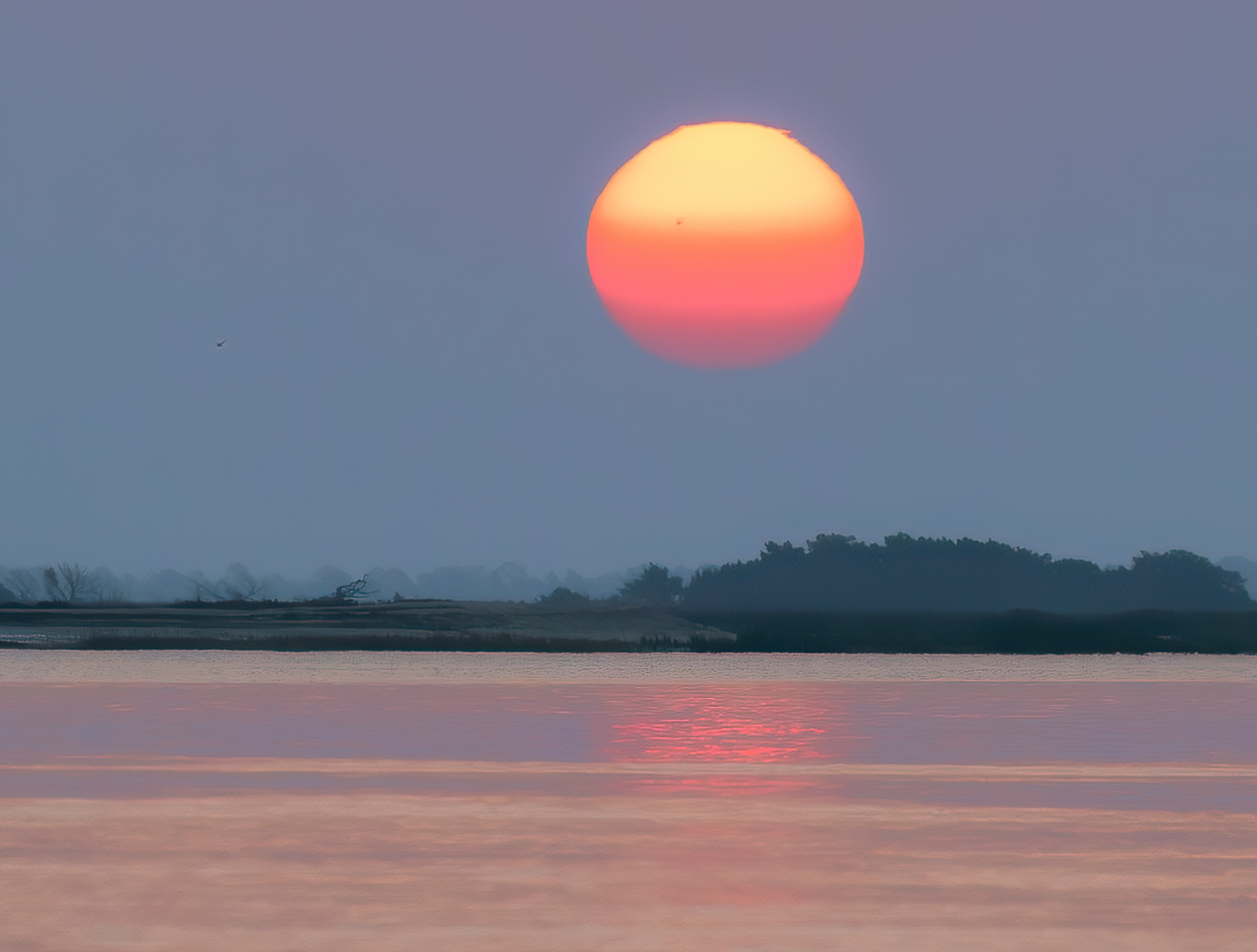
Smoke-inspired Sunrise
Even before we launched, the morning was full of birdsong. Painted Buntings sang from the palmettos and live oaks surrounding the boat landing, their sharp metallic calls carrying through the darkness before dawn. Painted Buntings are often associated with shrubby coastal habitat and maritime edges near water during the breeding season in the Lowcountry. Read more about Painted Buntings in my blog post linked here.
As we idled away from the landing and passed Dataw Island, the sun slowly emerged through the haze. The tide was still high, flooding much of the marsh edge and covering portions of the mudflats and oyster bars that shorebirds depend on during migration.
Still, scattered sandbars and exposed flats began appearing ahead of us as we moved toward the outer islands.mMy target species for the trip was the Whimbrel — one of the clearest signs of spring migration along the South Carolina coast.
The Hudsonian Whimbrel and the South Carolina Coast
Each spring, Whimbrel, a type of curlew, move north along the Atlantic Flyway on an extraordinary migration from wintering grounds in South America toward Arctic breeding territories in Canada and Alaska. Along the South Carolina coast, they pause to rest and refuel on tidal mudflats, oyster beds, salt marshes, and barrier island shorelines.
One of the most important staging areas for Whimbrels on the Atlantic coast is Deveaux Bank near Charleston, roughly 70 miles north of Otter Island as the crow flies. During migration, thousands of Whimbrels may concentrate there, making it one of the most significant Whimbrel stopover sites in North America. Researchers continue to study how South Carolina’s barrier islands function together as an interconnected network of feeding and roosting habitat during migration. Watch to learn how an amazing discovery unfolded at Deveaux Bank - link here.
As we approached Otter Island, the Whimbrels were not tightly packed into dense resting flocks. Instead, they were spread loosely across sandbars, mudflats, and oyster edges feeding quietly in the early morning light. The high tide limited the amount of exposed shoreline habitat, concentrating activity along the remaining exposed edges. The island system seemed to function as a daytime foraging ground where the birds could feed, rest, preen, and conserve energy during migration.
Watching them move slowly across the flats, probing the mud with their long curved bills, reinforced how dependent these migrants are on healthy tidal ecosystems. Whimbrels primarily feed on crabs and marine invertebrates during migration, often walking methodically through shallow water and mudflats while probing for prey
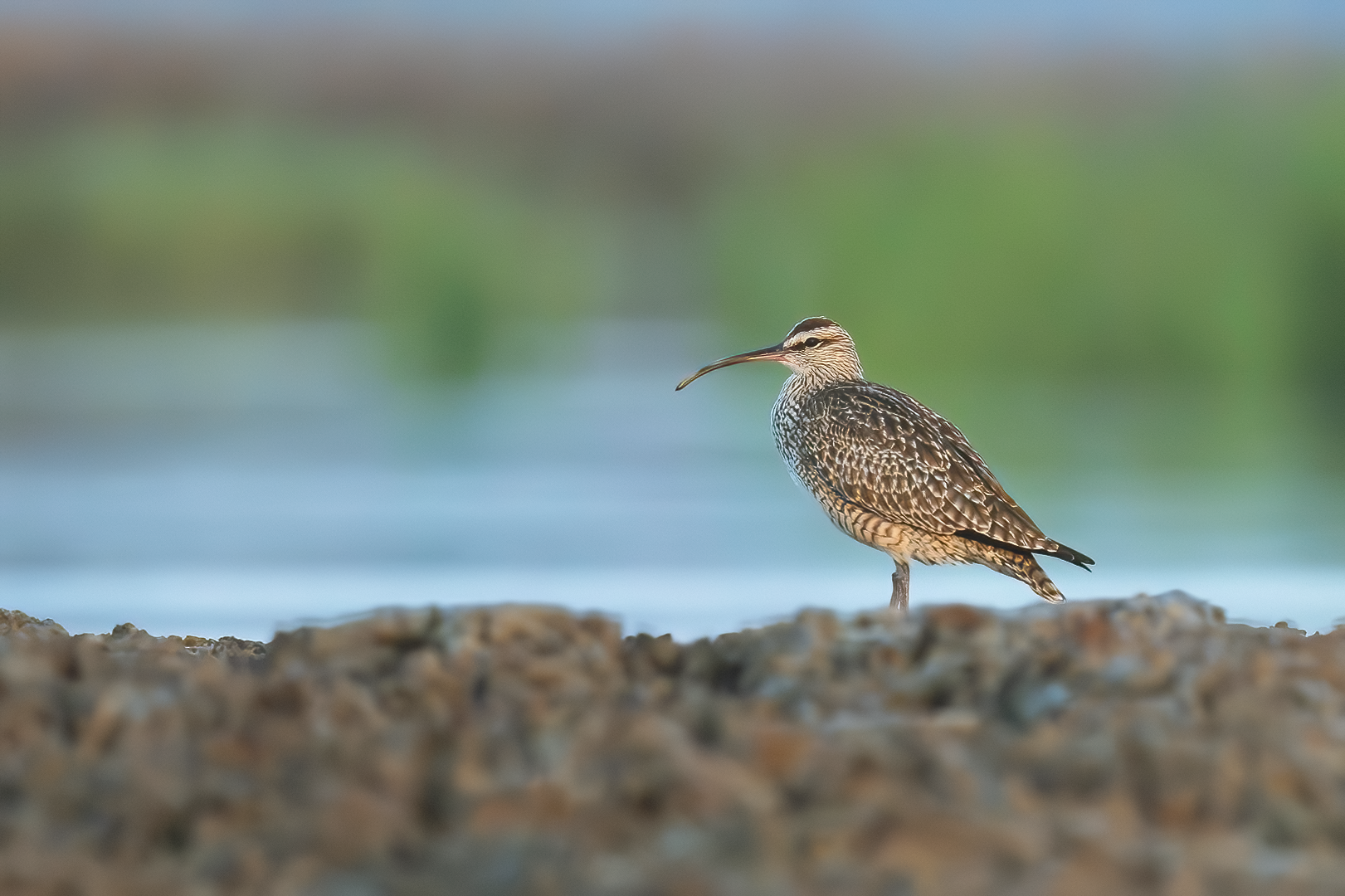
Hudsonian Whimbrel
Researchers studying satellite-tagged birds have documented that some Whimbrels stopping along the South Carolina coast continue north in remarkable nonstop flights covering thousands of miles. Migration timing is influenced by several environmental cues, including increasing day length, weather systems, favorable winds, food availability, and hormonal changes tied to seasonal cycles.
Standing on a barrier island mudflat in April, it is difficult not to wonder how these birds know precisely when to leave. One day they are feeding quietly along the edge of an oyster rake in the ACE Basin. Days later, they may be crossing entire regions of North America on their way to the Arctic tundra.
To learn more about when the birds know to leave, I recommend reading Flight Paths: How a Passionate and Quirky Group of Pioneering Scientists Solved the Mystery of Bird Migration.
Otter Island and the ACE Basin
Otter Island sits within the vast ACE Basin — one of the largest undeveloped estuaries on the Atlantic coast. The name ACE comes from the Ashepoo, Combahee, and Edisto Rivers, which converge to form an immense network of tidal marshes, creeks, hammocks, and barrier islands.
Unlike many developed coastal areas farther north and south, much of the ACE Basin remains protected, creating critical habitat for migratory birds, shorebirds, wading birds, raptors, and marine life. Otter Island itself remains largely undeveloped and inaccessible except by boat. Its shifting shorelines, shell rakes, marsh edges, and exposed sandbars provide ideal habitat for migrating shorebirds during spring migration.
As we approached the island, the shoreline came alive with birds. Most of the shorebirds were already in vibrant breeding plumage.
I observed:
Whimbrel
Willet
Dunlin
Sanderling
Ruddy Turnstone
Semipalmated Plover
Black-bellied Plover
Short-billed Dowitcher
Spotted Sandpiper
American Oystercatcher
Because the tide remained relatively high, the birds appeared relaxed rather than frantic. Some fed quietly along the shoreline while others rested, preened, or stood sleeping in small groups along the edges of oyster beds and mudflats. The calmer behavior created excellent photographic opportunities.

Ruddy Turnstone and Forster’s Tern
Overhead, Brown Pelican — the state seabird of South Carolina (read more here) — cruised low above the water. I also observed:
Turkey Vulture
Laughing Gull
Forster's Tern
Royal Tern
Osprey
Photographing Spring Migration from a Small Boat
Photographing birds from a small boat presents its own challenges. The biggest obstacle is stability. Even on relatively calm water, the boat is constantly moving beneath you. For this trip, I carried two camera setups:
a Nikon Z8 paired with a NIKKOR Z 180-600mm f/5.6-6.3 VR
and a Nikon Z9 with a NIKKOR Z 400mm f/4.5 VR S
The flexibility of the 180–600mm zoom proved especially useful from the boat when birds shifted position quickly or distances changed unexpectedly along the shoreline. The lightweight 400mm f/4.5 prime created beautiful subject separation and worked particularly well for isolating Whimbrels and other shorebirds against the layered backgrounds of water, marsh, and oyster beds.
Our guide, Lowcountry Photo Safaris owner Eric Horan, did a masterful job positioning the boat slowly and carefully while balancing both our safety and the wellbeing of the birds we were photographing.
One of the simplest techniques for improving stability is remaining seated whenever possible:
feet firmly planted
camera up
shoulders back
elbows tucked in
At times, I sat directly on the floor of the boat and rested my lens along the edge for a lower shooting angle closer to the waterline.
In a small boat like this, tripods are impractical. Instead, I compensated for movement by increasing shutter speed to offset both boat drift and subject motion.
We were fortunate:
calm seas
little wind
almost no bugs
Conditions that are never guaranteed in the Lowcountry in late April.
What struck me most compositionally was how layered the landscape felt. Water. Mudflats. Oyster beds. Sand. Marsh grass. Sky.
These uninhabited barrier islands create naturally layered backgrounds that seem perfectly designed for shorebird photography, especially in early morning light softened by smoke in the atmosphere. And at this time of year, the opportunity is fleeting.
For overwintering shorebirds along the South Carolina coast, spring offers a brief window when many species transition into their full breeding plumage before departing north. Some, like the Whimbrel, are only passing through during migration, while others have spent the winter here and are now transforming into far more vibrant versions of the birds we see during the colder months. Somehow, the shorebirds gathered on these remote islands seemed more intensely colored than birds I had recently photographed along public beach sandbars.
Perhaps it was the light.
Perhaps the habitat.
Or perhaps simply the feeling of seeing them in a quieter, less disturbed place.

Black-bellied Plover (breeding)
The Rhesus Monkeys of Morgan Island
The trip also brought us past Morgan Island — better known locally as Monkey Island. The island is home to thousands of free-ranging rhesus macaques that were relocated there in the late 1970s from a research colony in Puerto Rico. Today, the island remains closed to the public and monitored. Landing is prohibited, with warning signs posted along the shoreline.
Seeing monkeys just offshore in the South Carolina Lowcountry feels surreal. At first glance, the island almost appears tropical or jungle-like rather than distinctly coastal South Carolina.
From the boat, we observed groups of monkeys resting near the shoreline and moving through the tree canopy. Younger monkeys appeared lighter in color and were actively chasing and playing with one another among the branches. Others appeared to be feeding along the palm trunks and forest edge. Rhesus macaques on the island survive on a varied diet that includes seeds, fruits, leaves, bark, insects, and other available vegetation.
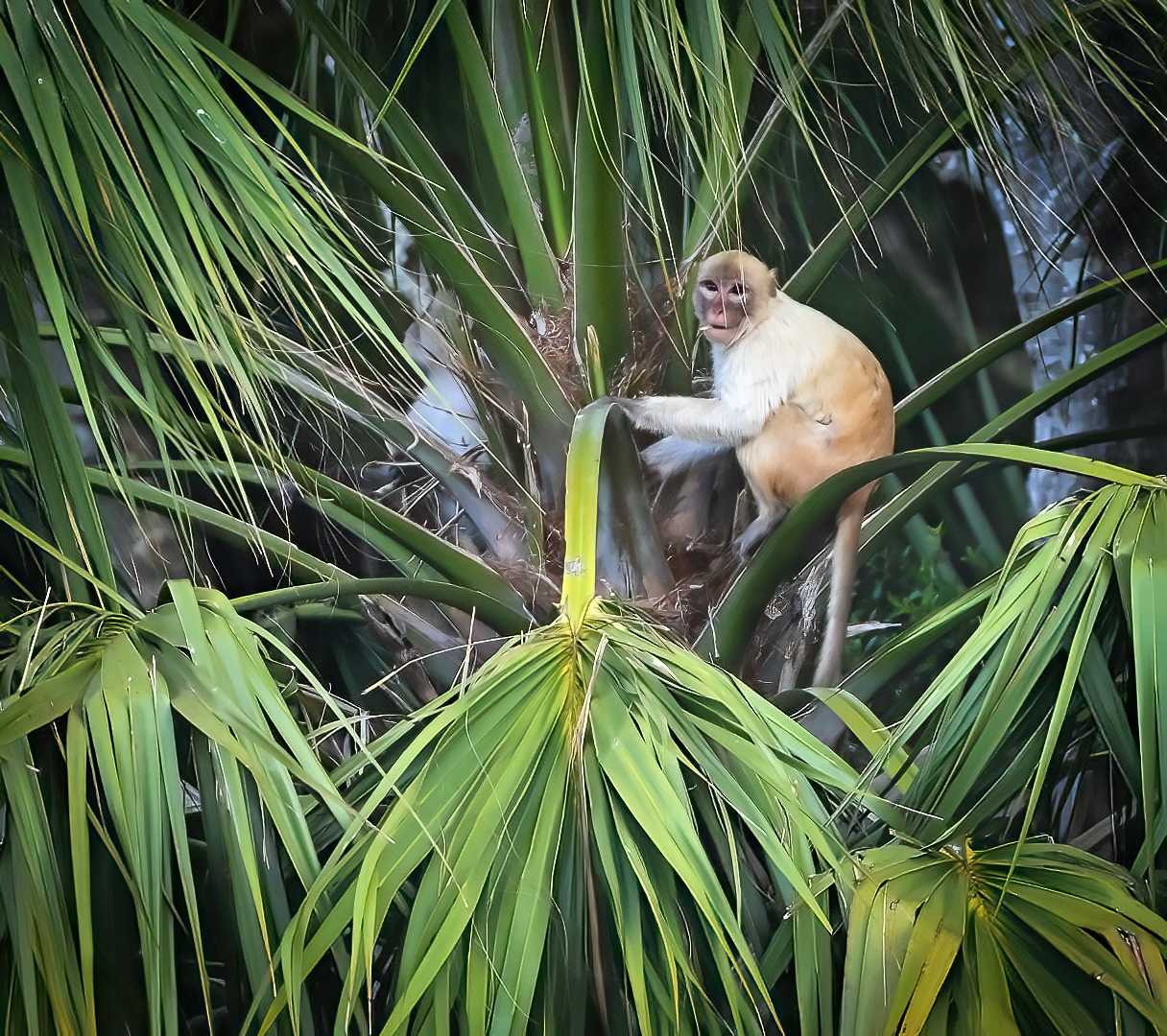
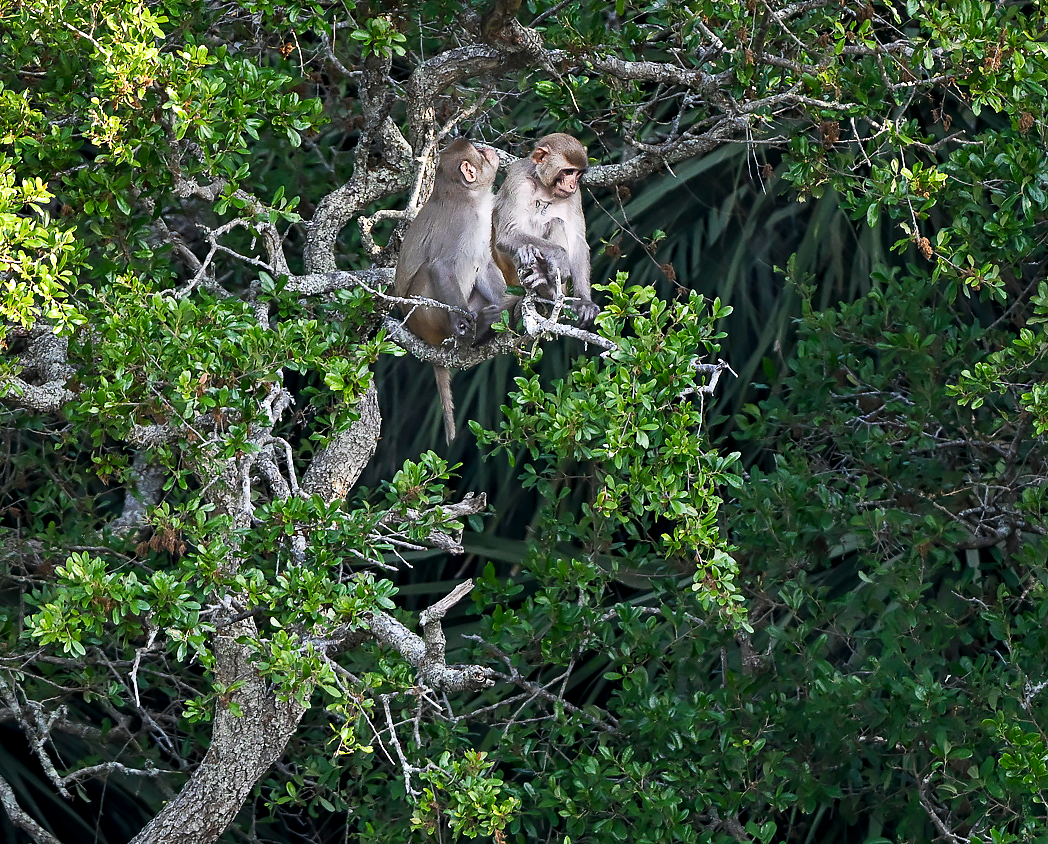
On this particular morning, the monkeys never emerged onto the beach to forage or bathe along the shoreline. Instead, they mostly remained partially hidden within the forest canopy. Their expressions struck me as unexpectedly solemn at times — observant, cautious, almost sad.
And yet the entire encounter felt improbable:
monkeys in palmettos,
shorebirds on tidal flats,
smoke-filled skies over the ACE Basin,
all unfolding within a single Lowcountry morning.
Birding the Lowcountry by Boat
Experiencing spring migration from the water offers a completely different perspective on the South Carolina coast. Many of the barrier islands, shell rakes, and tidal mudflats used by migrating shorebirds are inaccessible by land, and approaching them carefully by boat allows you to observe both the birds and the broader coastal landscape in a much more immersive way.
If you are interested in photographing or observing shorebirds, seabirds, dolphins, marsh wildlife, and the remote barrier islands of the Lowcountry, I highly recommend Eric Horan of Lowcountry Photo Safaris. Eric combines strong field knowledge of tides, bird behavior, and the ACE Basin with a thoughtful and ethical approach to wildlife photography from the water.
You can learn more about his tours and photography workshops at Lowcountry Photo Safaris.

Black-bellied Plover (breeding)
Returning to Saint Helena Island
By the time we returned to Eddings Point Landing, the boat ramp and surrounding trees were once again full of birdsong.
I could hear:
Orchard Oriole
Painted Bunting
Blue-gray Gnatcatcher
Eastern Bluebird
Great Crested Flycatcher
Spring migration in the Lowcountry often feels temporary and constantly in motion.
The tides shift.
The light changes.
Birds arrive overnight and disappear just as quickly.
But for a few hours that morning, between Saint Helena Island, Otter Island, and Morgan Island, migration slowed long enough to observe it closely.
Disclosure: This post contains Amazon affiliate links. As an Amazon Associate, I earn from qualifying purchases.