
Painted Bunting South Carolina: Season, Spots, and Field Notes from the Lowcountry
It is that time of year again. Late March into April, and the question I hear most from visitors is some version of the same thing: where can I see a Painted Bunting, and when? It is the right question to be asking right now, because the birds are on their way.
Painted Buntings are not long-distance migrants. The eastern population — the birds that breed here in the Lowcountry — winters in south Florida, the Bahamas, and Cuba, a relatively short trip compared to the trans-continental journeys of many songbirds. They depart the breeding grounds in August and September, spend the winter in the northern Caribbean and south Florida, and begin moving north again in March. By late March the first arrivals are filtering back into coastal South Carolina. By May, males are singing from every brushy thicket along the barrier islands.
The Painted Bunting is not subtle. A breeding male is bluer than an Indigo Bunting on its head, greener than a Ruby-throated Hummingbird on its back, and redder than a Northern Cardinal on its throat and breast. There is no other small bird in North America that looks remotely like it. And South Carolina — specifically the sea islands and coastal scrub of the Lowcountry — is the center of the eastern breeding world for this species.
If you're visiting Hilton Head Island or anywhere along the coast between Charleston and Savannah in spring, a Painted Bunting encounter is genuinely possible. But it takes the right timing, the right habitat, and patience. This post covers all of it.
Why Coastal South Carolina Is Painted Bunting Country
The Painted Bunting's eastern subspecies — Passerina ciris ciris — breeds along just a narrow corridor of the Atlantic Coast: North Carolina, South Carolina, Georgia, and northern Florida. That's the entire breeding range for the eastern population. South Carolina sits at the heart of it.
According to the South Carolina Department of Natural Resources 2015 State Wildlife Action Plan, South Carolina supported an estimated 54 percent of the total eastern population of breeding adults. The highest densities occur specifically around the sea islands of South Carolina and Georgia — the Lowcountry's maritime landscape of shrub-scrub, tidal edges, and open forest corridors is precisely the habitat this bird seeks.
John James Audubon gave the Painted Bunting its French nickname, nonpareil — "having no equal." The bird has also been called the Painted Finch in older field literature and among birders in the Southeast, though that is a folk name rather than a taxonomic one — it belongs to the cardinal family, Cardinalidae, not the true finches.
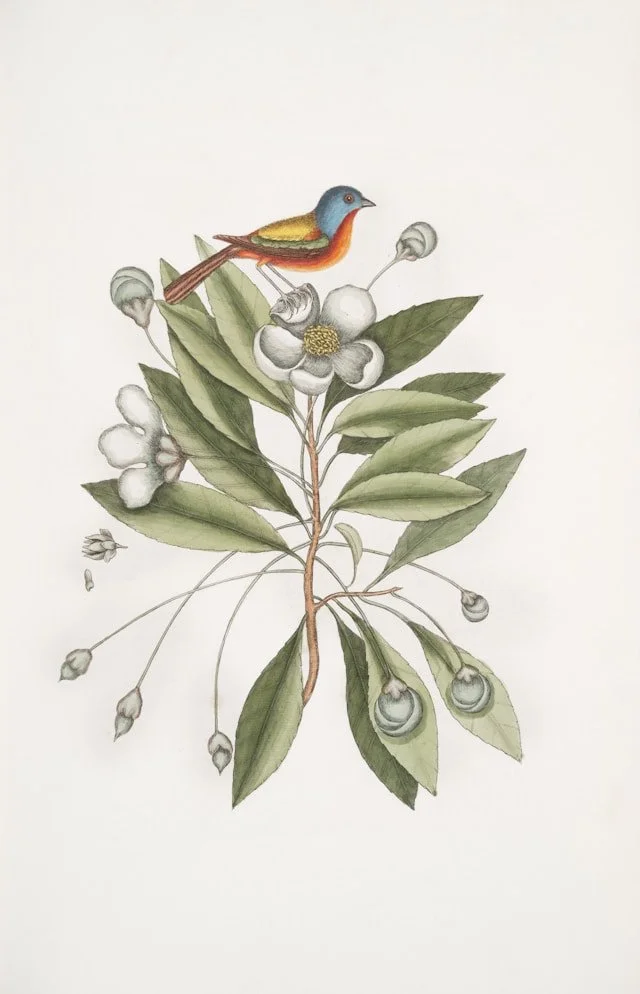
Painted Finch
Rare Book Division, The New York Public Library. "Althea [Alcea] Floridana, The Loblolly-Bay; Avis Tricolor, The Painted Finch." The New York Public Library Digital Collections. 1754. https://digitalcollections.nypl.org/items/510d47da-64e2-a3d9-e040-e00a18064a99
Once the breeding season ends, eastern Painted Buntings vacate the Lowcountry entirely, wintering in south Florida, Cuba, the Bahamas, and the wider Caribbean. From late March through August, South Carolina is their home. The rest of the year, the brushy thickets where they sang all summer sit quiet.
For context on how spring migration timing plays into Painted Bunting arrivals, Spring Flight in Motion: Spotting the Signs of Bird Migration Along the South Carolina Coast walks through what the coast looks like as neotropical migrants move through.
How to Identify a Painted Bunting
Male
There are no lookalikes. A male Painted Bunting has a deep blue head, a bright green back, and a red throat, breast, and rump. The colors don't blend into one another — they sit in distinct, saturated blocks. If you see a small songbird at the edge of a brush pile and your first thought is "that can't be real," it's probably a male Painted Bunting.
In flight, males can be briefly confusing — the size and silhouette are sparrow-like, and you catch color only for a second. But when they land and settle in open view, there's no uncertainty.
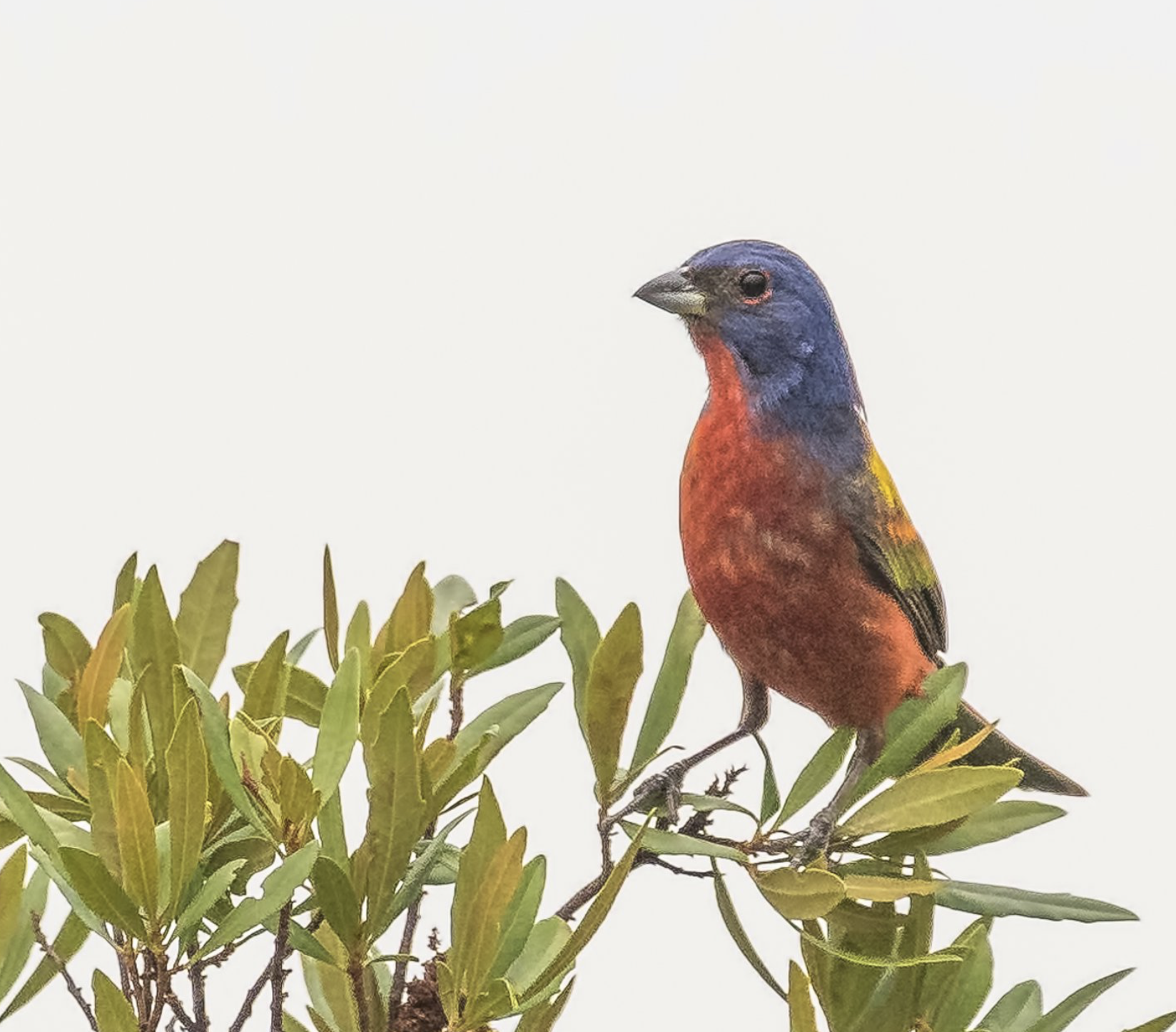
Female and Immature
The female is bright yellow-green overall, paler below, with a faint eye ring. Immature birds of both sexes look similar to females. This plumage is actually quite distinctive once you know it — the yellow-green is warmer and cleaner than most warblers or vireos — but at a feeder or in dense brush, it's easy to overlook as "just a greenish bird."
Both sexes are small, roughly sparrow-sized. The Painted Bunting is not a bird that perches prominently in the open. It prefers the interior of low, dense scrub and tends to move quickly between cover. You are more likely to hear a male before you see one.
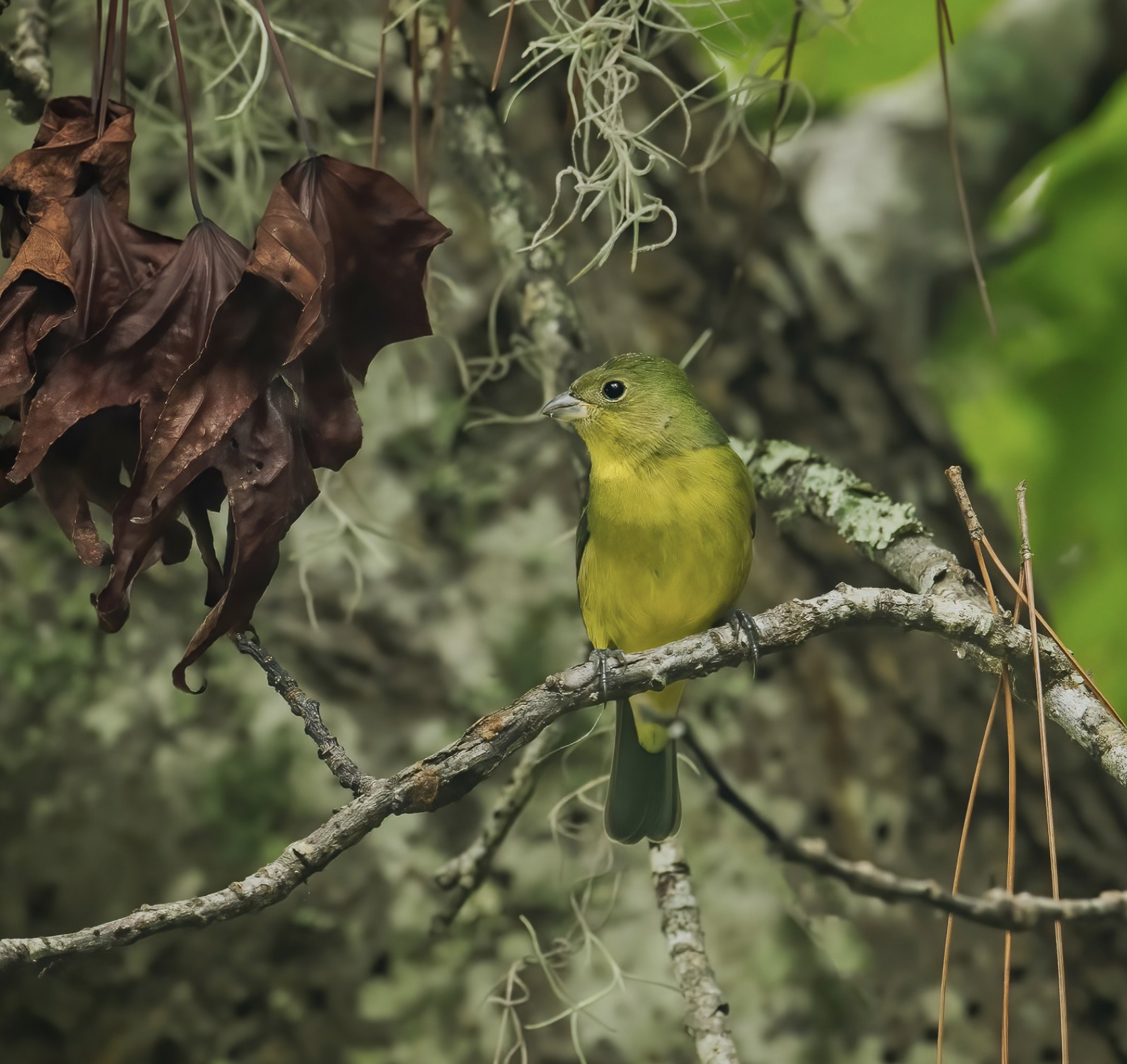
Female Painted Bunting in my backyard, Hilton Head Island
Identifying by Song
The song is one of the most useful identification tools you have with this species. Males sing persistently through the breeding season, and the song carries well across open scrub and marsh edge. It is a rapid, high, sweet warble — sweeter and more continuous than an Indigo Bunting, brighter than a Warbling Vireo. Once you know it, you will hear Painted Buntings in places where you would never have spotted them visually. Birding by ear is genuinely easy with this species: there is nothing else in the Lowcountry that sounds quite like it in spring. You can listen to recordings at the Cornell Lab All About Birds — Painted Bunting sounds page before your visit, or browse more than 120 field recordings from across the range — including South Carolina — at Xeno-canto.
Season and Timing: When They Arrive and When They Leave
Painted Buntings begin arriving in the Lowcountry in late March, with numbers building through April. By May, breeding males are actively singing to establish territory, and the species is at its most detectable. June is still good, though activity shifts as nesting gets underway. July and August bring a gradual drop in singing, and by September most birds have moved south.
The practical window for most visiting birders is May through mid-June. Males are vocal, singing from exposed perches at the edges of dense cover, and the light is better in May than in the haze of midsummer. That said, early April arrivals are documented on eBird every year, and if you're here during the last week of March, it's worth checking known spots.
The best time of day is early morning. Males sing most actively in the first two hours after sunrise, often from a slightly elevated position — a shrub top, a low branch, a fence post at the edge of a field. Once the morning heats up, they drop back into cover and become far harder to locate.
Where to Find Painted Buntings on Hilton Head Island and the Lowcountry
The habitat pattern to look for is consistent: maritime shrub-scrub, brushy woodland edges, and overgrown fields near freshwater. Painted Buntings avoid dense closed-canopy forest and open lawns equally. The sweet spot is transitional cover — thickets, hedgerows, areas where trees meet open ground.
Before any outing, run an eBird search for "Painted Bunting" plus the location name. Recent sightings will show you which specific spots are active that week, and eBird checklists often include notes on exact location within a larger park.
Fish Haul Beach Park, Hilton Head Island
Fish Haul Beach Park on the north end of Hilton Head has the right combination of habitats: maritime forest, brushy field edges, and marsh proximity. It comes up regularly on eBird during spring migration and early breeding season. The forest interior connects directly to open scrubby areas, which is exactly where buntings use the edge.
Patience is the word at Fish Haul. The birds are there, but this is not a park where they present themselves readily. Move slowly along the trails, stop often, and listen before you look. A male singing in dense cover at Fish Haul can take a long time to work into view.
Sea Pines Forest Preserve
The Sea Pines Forest Preserve offers a different habitat profile — more mature maritime forest with interior ponds — but Painted Buntings have been documented here, including photographed males in the South Beach area. The brushy edges along forest openings and around the preserve's freshwater areas are the most productive zones to check.
Pinckney Island NWR
Pinckney Island National Wildlife Refuge sits just off U.S. 278 before the bridge onto Hilton Head and has a documented history of Painted Bunting sightings — including multiple males seen simultaneously from the parking area during breeding season. The brushy edges along the impoundment dikes and the scrub-forest transition zones are worth working carefully.
The refuge covers significant acreage, and Painted Buntings are not uniformly distributed throughout. Check recent eBird data to focus your time. For a sense of the refuge's winter and year-round character, A Winter Walk Through Pinckney Island NWR covers the landscape well.
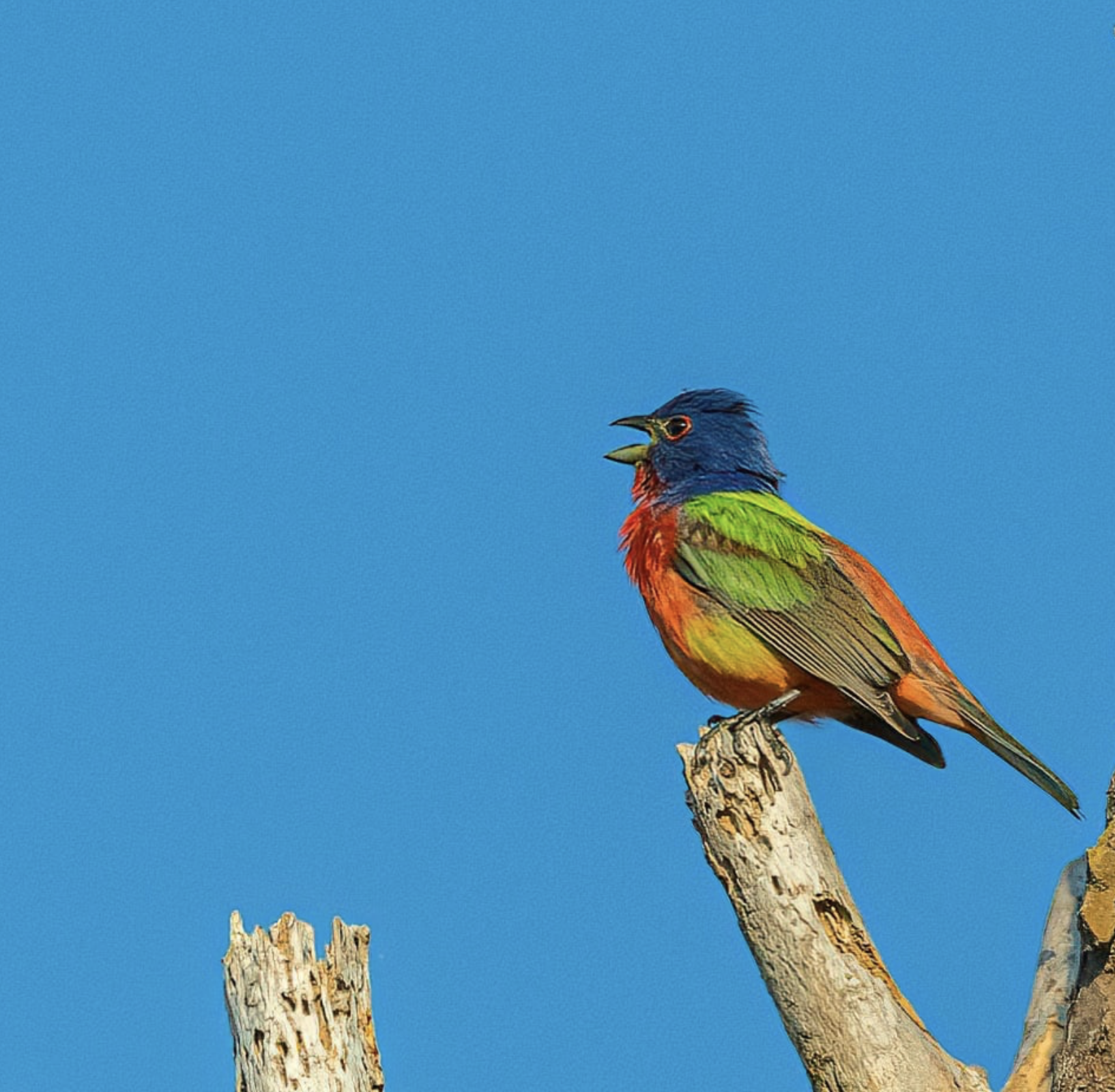
Painted Bunting singing on a snag along the main trail at Pinckney Island NWR
Broader Lowcountry
Beyond Hilton Head, the coastal Lowcountry holds several productive Painted Bunting locations. Hunting Island State Park south of Beaufort has consistent records. Bulls Island at Cape Romain National Wildlife Refuge north of Charleston is considered one of the better spots on the entire coast. The Awendaw corridor along U.S. 17 north of Charleston — where scrubby maritime habitat stretches for miles — also holds a strong breeding population.
If your trip allows for a day trip from Hilton Head, any of these sites in late May or early June can be productive. The key habitat features remain the same: shrubby edges, not forest interior, not manicured lawn.
Backyard
If you live on Hilton Head or anywhere in the coastal Lowcountry, a backyard setup can bring Painted Buntings to you. The formula is straightforward: white millet seed on a platform feeder or scattered on the ground is the primary draw — avoid mixing it with sunflower seed, which pulls in larger birds that will dominate the feeder. A caged tube feeder filled with white millet is worth adding alongside a platform; the cage excludes grackles and Blue Jays while giving smaller birds like buntings a secure place to feed. A shallow birdbath placed near shrubs completes the setup — buntings are drawn to water, and a dripper or bubbler attachment is more effective than still water. Plant cover matters too: wax myrtle, yaupon holly, and beautyberry are all native to the Lowcountry and provide the dense, low shrubby edge that buntings look for. The less manicured the yard, the better your chances.
Field Notes and Photography Tips
The approach that works for Painted Buntings is the same approach that works for most secretive songbirds: arrive early, move slowly, and then stop moving entirely.
Start by listening. A male Painted Bunting singing from dense cover will call attention to itself vocally long before it gives you a visual. Use that time to position yourself at the edge of the cover — not crashing into it, but standing or sitting at a spot where you can see the transitions: the gap between two thickets, the edge of a field, a shrub-topped fence line. Males will often move through these openings when they shift between singing perches.
Once you've found a bird's general territory, the most reliable photography approach is to identify a spot where the bird appears repeatedly — a specific exposed branch, a feeder if one is set up nearby — and wait there rather than following the bird through the brush. White millet feeders are known to attract Painted Buntings, and if you're working a yard or a fixed location with a feeder, that predictability makes for a cleaner shot with better light control than chasing a bird through moving foliage.
Early morning light is essential for the male's colors. The combination of blue, red, and green means the bird is simultaneously reflecting across the spectrum, and flat midday light flattens it. Soft directional morning light brings out the depth in those colors in a way that high sun does not.
For technical tips on working in the field with difficult light and vegetation, How to Photograph Birds in Marshes and Mudflats covers the mechanics of shooting in transitional Lowcountry habitats. The broader philosophy of slowing down and letting birds come to you — rather than pressing toward them — is something Mindful Birding in the Lowcountry addresses directly. It applies here as much as anywhere.
One practical note: spring in the Lowcountry means heat, humidity, and biting insects by mid-morning. If you're planning a serious morning session at a spot like Fish Haul or Pinckney Island, dress accordingly. What to Wear Birding in the Lowcountry covers exactly this — it's not glamorous but it matters when you're standing still in the brush at 7 a.m. in June.
The Painted Bunting is not rare in South Carolina. It is, however, a bird that rewards the birder who shows up early, knows the habitat, and waits. The Lowcountry gives you the habitat. The rest is yours to provide.
If you’d like to explore these habitats with a local guide, you can learn more about my guided birding and bird photography outings click here.
Hilton Head Island and the surrounding Lowcountry offer some of the best coastal birding on the Atlantic Flyway, and I’m always happy to help visitors and local residents discover the birds and habitats that make this region so special.
You can learn more about Hilton Head’s birds, habitats, and photography in my book Flight Through the Seasons, available on Amazon.
Disclosure: This post contains Amazon affiliate links. As an Amazon Associate, I earn from qualifying purchases.