
Meet the Orange-Alert Shorebirds of Hilton Head Island Part 2: Red Knot (A Species at a Tipping Point)
This is Part 2 in a series on Orange Alert shorebirds. Read Part 1: Black-bellied Plover to learn more about another species facing population decline.
April into May marks a turning point along the Atlantic Flyway. Shorelines shift from quiet winter rhythms to movement—purposeful, urgent, and precise—as birds move south to north toward their summer breeding grounds.
Here on Hilton Head Island, the mudflats and sandbars become more than landscape. They are essential stopover habitat—a place to rest, refuel, and prepare for the next leg of a long journey.
I set out the last two mornings pre-dawn, timing my walks with the tides. Both mornings offered ideal conditions—temperatures in the 50s and 60s, light breezes, and notably, no gnats. The tide was 2–3 hours past high, exposing the mudflats and concentrating marine life—exactly what feeding shorebirds depend on.
At the rivulet crossing, I was greeted first by a small flock of Yellow-crowned Night Herons, actively fishing for crabs as the marsh drained. The current was strong—water rushing, swirling around their legs. True to their name, they were feeding in the last stretch of darkness before dawn.
Nearby stood a solitary Great Blue Heron—measured, composed, and deliberate in its movements. From the forest edge, the steady call of a Tufted Titmouse carried through the stillness. As I stepped onto the sandbar, the shoreline came alive. Sanderlings darted along the water’s edge, followed by a Black-bellied Plover. Then the sky began to shift.
First light—soft pink tones on the horizon—and with it, motion.
Birds lifted from distant roosts. Murmurations formed and dissolved overhead. Black Skimmers, Dunlin, Laughing Gulls, Willets—moving in loose, fluid formations before settling back to the shoreline. Once grounded, the quiet gave way to activity—preening, bathing, feeding, posturing and raucous calling.
Then, along the water’s edge, I found them, a small flock of eight Red Knots.
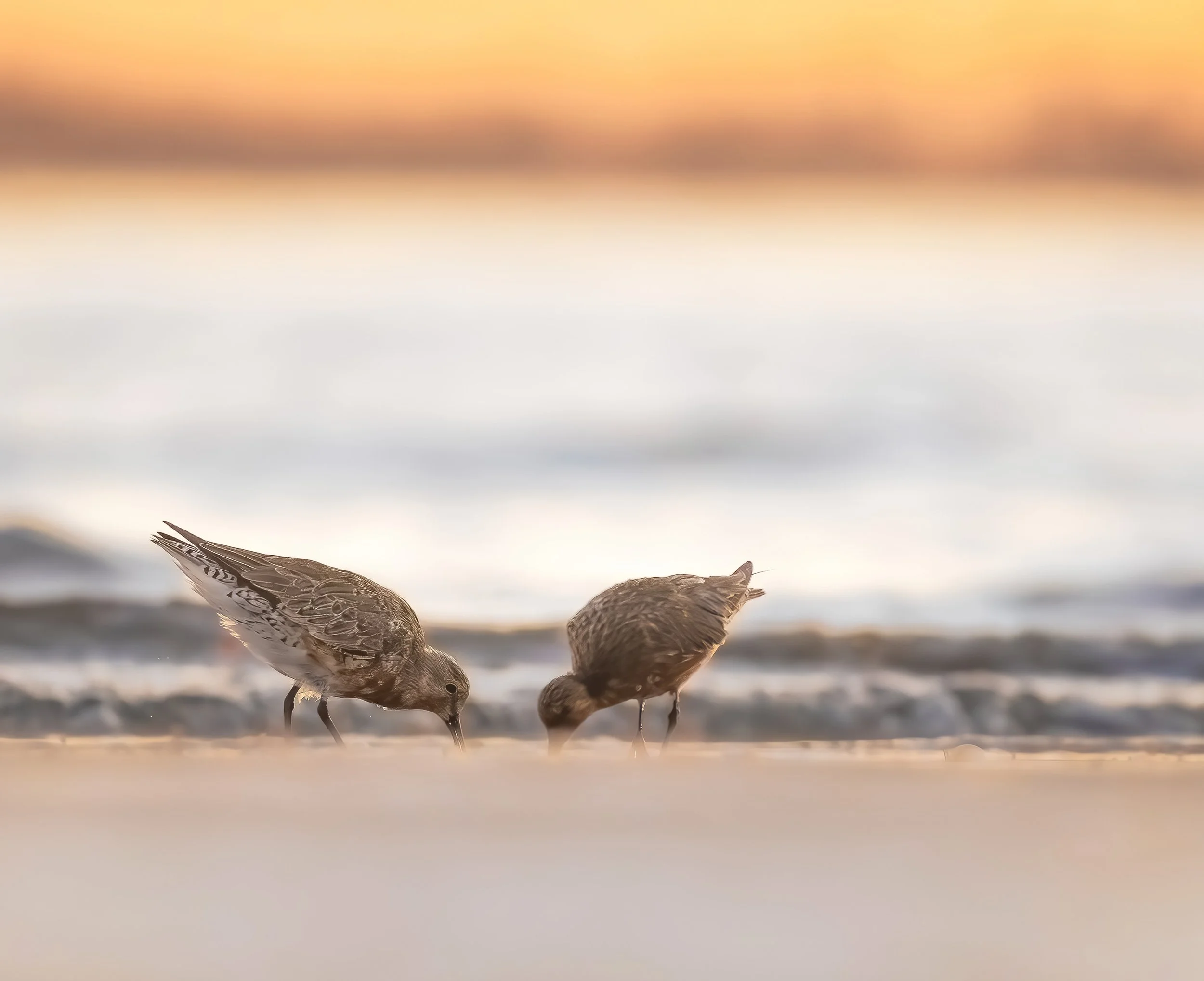
Red Knots
They moved as one—tight, coordinated, and fast. Feeding continuously. There was a clear urgency in their behavior, a sense of purpose. These are birds on a schedule. Their breeding plumage is just beginning to emerge—soft russet tones washing across their chests, with deeper browns along the back and wings. .
These are the mighty little shorebirds—among the most remarkable long-distance migrants in the world.
And there is something else—harder to define. A quality of kindness and peacefulness in their presence. Their round, dark eye, their calm expression. As I think about how to characterize them, the Italian word simpatico comes to mind.
Photographing with Care
As I was photographing them, I used a long lens—a 400mm prime with an extender—and began at a significant distance. I positioned myself low, lying in the sand, and made a slow, measured approach by crawling forward.
I did want to disturb or to interrupt their activity - they stayed settled and focused on feeding . And the broader shoreline—other shorebirds moving, preening, feeding—remained undisturbed. This is always the balance in shorebird photography: proximity versus impact. In moments like this, the decision is clear—the bird always comes first.

Red Knot showing breeding plumage
Red Knot: A Species at a Tipping Point
Like the Black-bellied Plover, the Red Knot is identified in the 2025 State of the Birds report as an Orange Alert species. But it goes a step further. The Red Knot is considered a “Tipping Point” species—meaning it has lost more than half of its population and continues to decline at an accelerated rate. According to the State of the Birds 2025
The Most Imperiled Birds
Shorebirds have the most Tipping Point species (19) of any group of birds in North America. Rates of shorebird declines exceed thresholds for listing as vulnerable/endangered under national and international conservation standards. Research on limiting factors and conservation actions is urgently needed to reverse declines.
Biggest Losses at Coastal Sites
Surveys show steep shorebird declines at migratory staging sites along the Atlantic Coast from North Carolina to Nova Scotia, as well as the Gulf Coast. Conservation actions to restore these critical coastal habitats will protect shorebirds, people, and property from storms, flooding, and sea level rise.
One of the Longest Migrations on Earth
The Red Knot (Calidris canutus rufa) undertakes one of the most extraordinary migrations in the natural world:
Travels up to 9,000 miles one way
Winters in southern South America, including Tierra del Fuego
Breeds in the high Arctic tundra
Hilton Head Island is one of many critical stopover points along this route.
Fueling the Journey
Red Knots are entirely dependent on timing and food availability:
They must rapidly gain weight at stopovers
Feed on coquina clams, small mollusks, and marine worms in exposed mudflats
In key locations like Delaware Bay, they rely heavily on horseshoe crab eggs
Every stop matters. Every tide cycle matters.
Why Places Like Hilton Head Matter
Barrier islands and tidal systems provide:
Reliable feeding habitat during receding tides
Space to rest between feeding cycles
A link in a chain of habitats stretching across continents
Even a small flock—eight birds along the shoreline—is part of a much larger migration system.
Conservation Reality
The Red Knot’s decline is tied to:
Loss and degradation of coastal habitat
Pressure on critical food resources
Disturbance during key migration windows
The Atlantic Flyway population has dropped significantly over the past several decades, leading to its listing as Threatened in the United States.
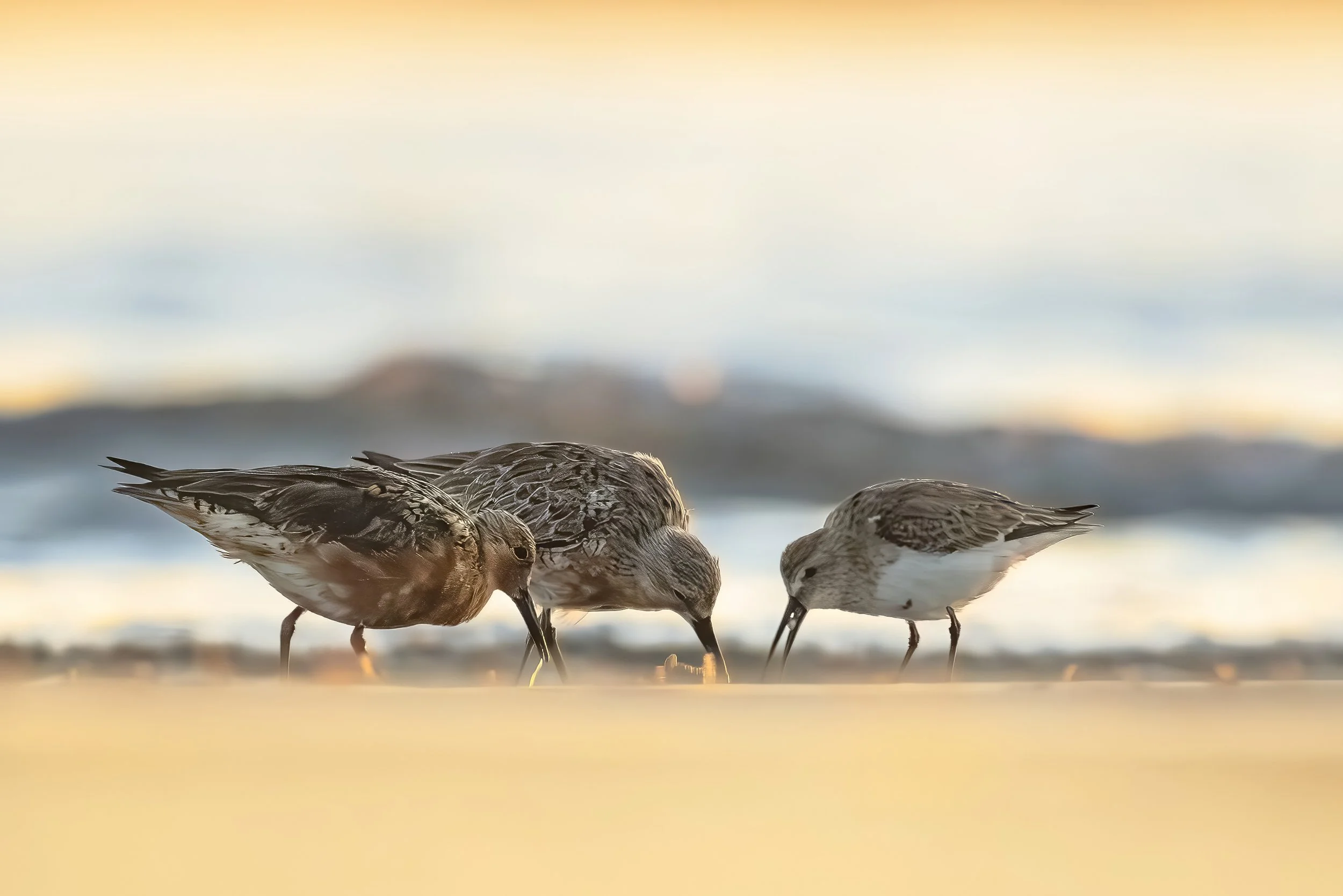
Two Red Knots and a Dunlin (left)
Closing Reflection
What stands out is not just the distance these birds travel, but the precision of it—the reliance on places like this, at exactly the right moment.
For a brief window each spring, Hilton Head becomes part of a hemispheric journey. And if you’re out there at first light, with the tide just right, you can witness it—eight birds at the water’s edge, moving with urgency, carrying on a journey that began thousands of miles away.
________________________________________________________
Not sure what to where birding the marshes and mudflats, read blog post: a Practical Guide to What to Wear Biding in the Lowcountry.
If you’d like to explore these habitats with a local guide, you can learn more about my guided birding and bird photography outings click here.
Hilton Head Island and the surrounding Lowcountry offer some of the best coastal birding on the Atlantic Flyway, and I’m always happy to help visitors and local residents discover the birds and habitats that make this region so special.
You can learn more about Hilton Head’s birds, habitats, and photography in my book Flight Through the Seasons, available on Amazon.
Disclosure: This post contains Amazon affiliate links. As an Amazon Associate, I earn from qualifying purchases.