
I love a good coastal storm, especially just before it arrives and again as it’s pulling away. When the wind pushes water onshore at high tide, I find myself watching the patches of marsh that are still above water, wondering where the birds will go as those patches disappear.
On one storm tide, I found four terns huddled together in a crevice in the marsh. What I remember is that each was a different species. A Royal Tern, a Forster’s Tern, a Caspian Tern, and a Sandwich Tern had all tucked themselves into that one small hollow. I’ve also seen Clapper Rails and a Yellow-crowned Night Heron making their way into the maritime forest, seeking higher ground as the water rose.
On this November visit to Fish Haul Beach, it was only about two hours past low tide. A coastal low was moving north offshore, a gale warning was in effect, and whitecaps were breaking beyond a sand spit where hundreds of Black Skimmers had gathered. As the tide rose around the spit, it pushed loose cordgrass into a clump at the edge of the shallows.
For some Black Skimmers, our stretch of coast is a place to spend the winter. During Hilton Head Audubon’s 2025 Christmas Bird Count, volunteers tallied 470 Black Skimmers across the local count circle. Over the ten counts from 2016 through 2025, the average was about 421 birds on count day. Banding records show that many skimmers hatched in South Carolina spend the winter farther south, along Florida’s Atlantic and Gulf coasts. Some of the birds on that November spit may have been settling in for winter, while others may have been resting on their way south.
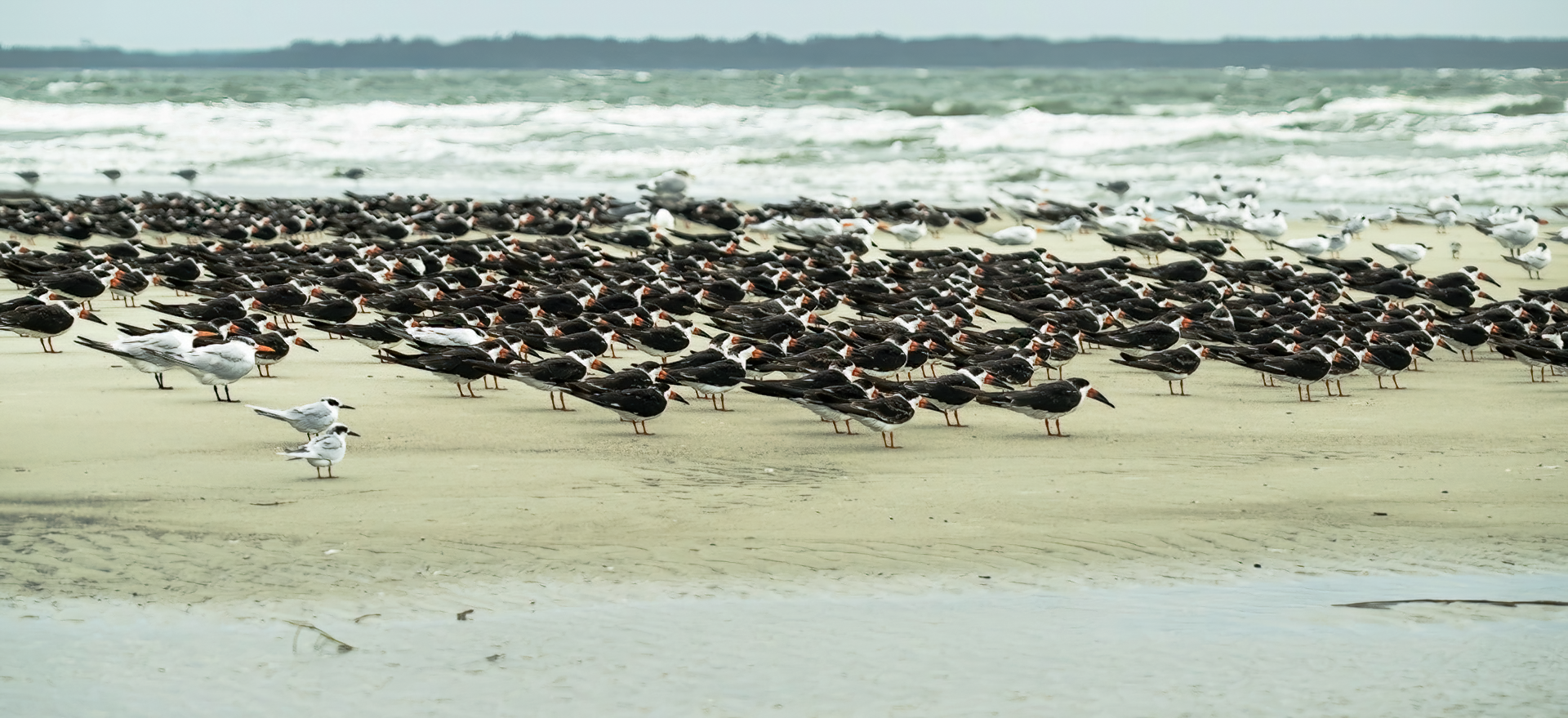
The incoming tide surrounds a sand spit crowded with Black Skimmers and Forster’s and Royal Terns.
Through my viewfinder I followed a skimmer flying low over a tidal pool with a stalk of cordgrass in its bill. The stalk was longer than the bird, and it hung at such an angle that the far end nearly touched the water. Several skimmers were scooping up stalks on the wing, and what held my attention was that they came back to the same patch of grass. At the edge of the spit, one skimmer stood poking its bill among the tangled stems. Its mottled crown made me suspect it was a young bird, and in my photograph its raised wing offered a better clue. Each of the little brown feathers on the upper wing had a pale edge, giving the whole patch a scalloped look. Here was a first-year Black Skimmer investigating the cordgrass on foot, in the very place the flying birds had returned to. I began to wonder whether some of them might be practicing
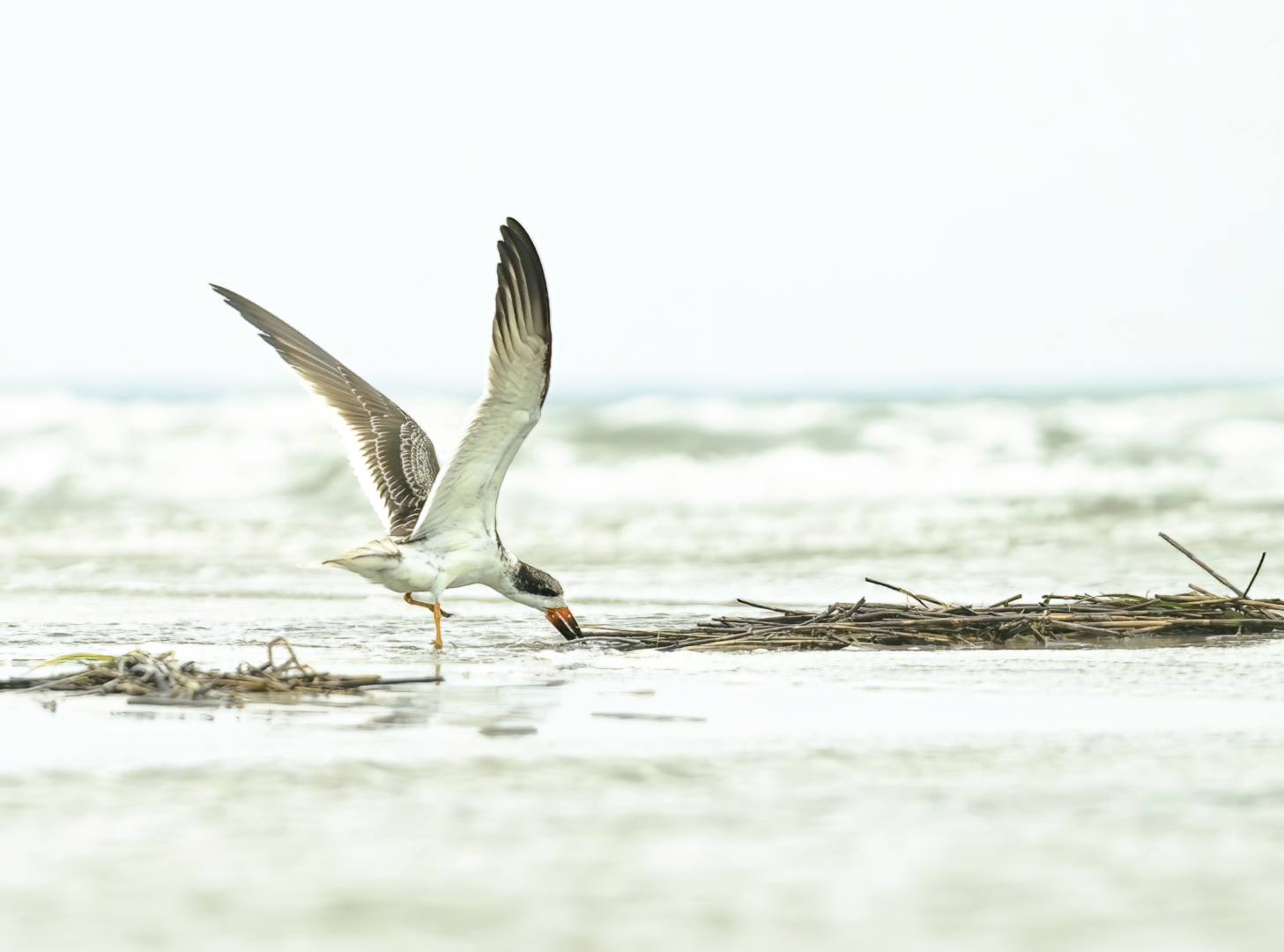
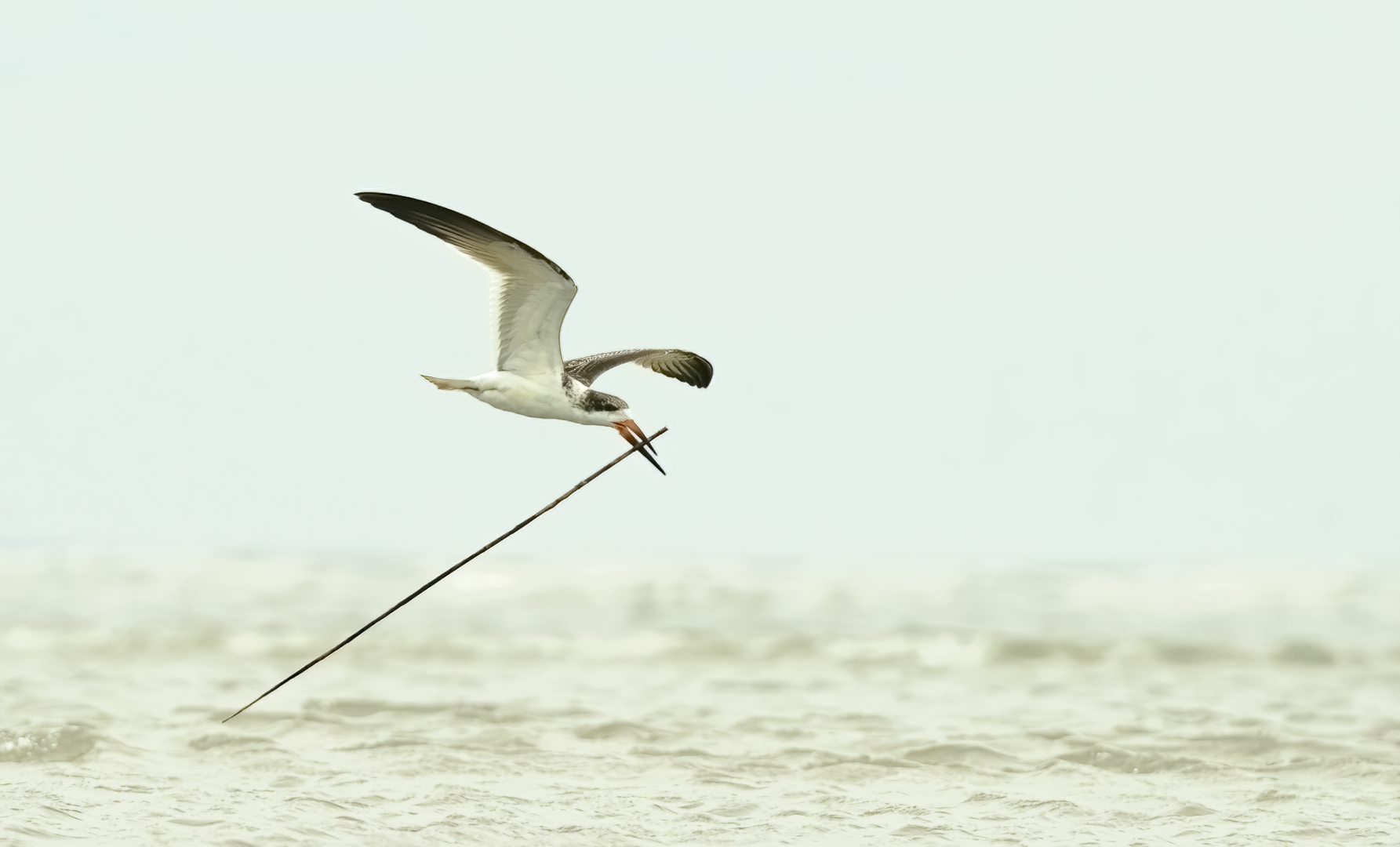
Another bird photographer had wondered much the same thing. On Long Island’s Nickerson Beach, Arthur Morris watched juvenile Black Skimmers pick up grass, seaweed, and small sticks as they skimmed the shallows, and he took those passes to practice. Decades earlier, ornithologist Richard Zusi had watched young skimmers at Stone Harbor, New Jersey, try skimming over dry sand. That detail stayed with me. Watching an adult skim, it’s easy to forget there was ever a time when it was still figuring out where to put its bill.
Of course, even an experienced skimmer could come up with a stalk of grass. A skimmer fishes by touch, drawing the longer, lower half of its open bill through the water and snapping it shut when it feels something. Researchers who studied the bird’s vision found that it can see the tip of its bill, which may help it inspect whatever it has just lifted from the water. New York State’s skimmer conservation plan describes birds catching stray vegetation this way and letting it go. With so much cordgrass gathered in one spot at Fish Haul, a bird could have been fishing on any of those passes.
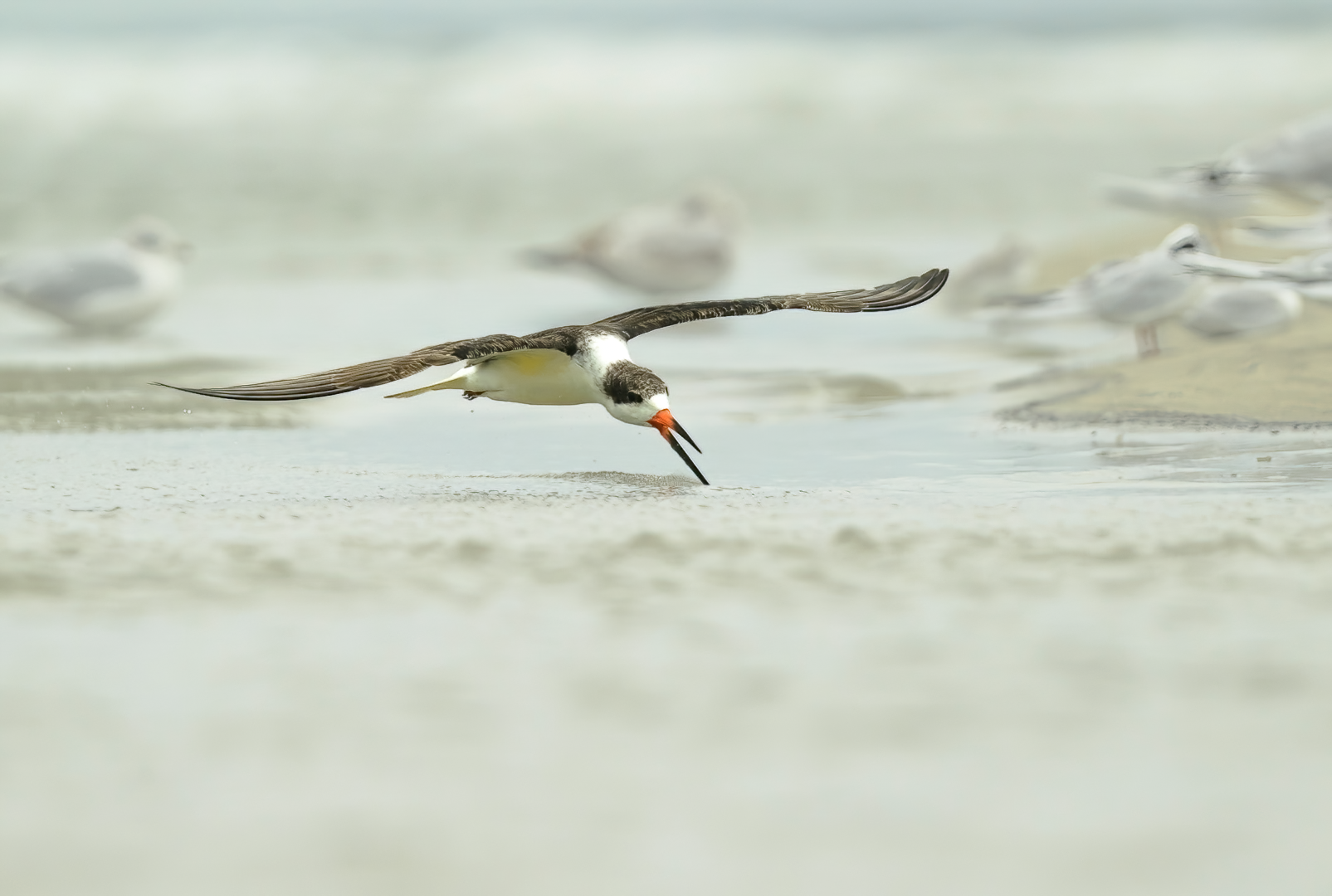
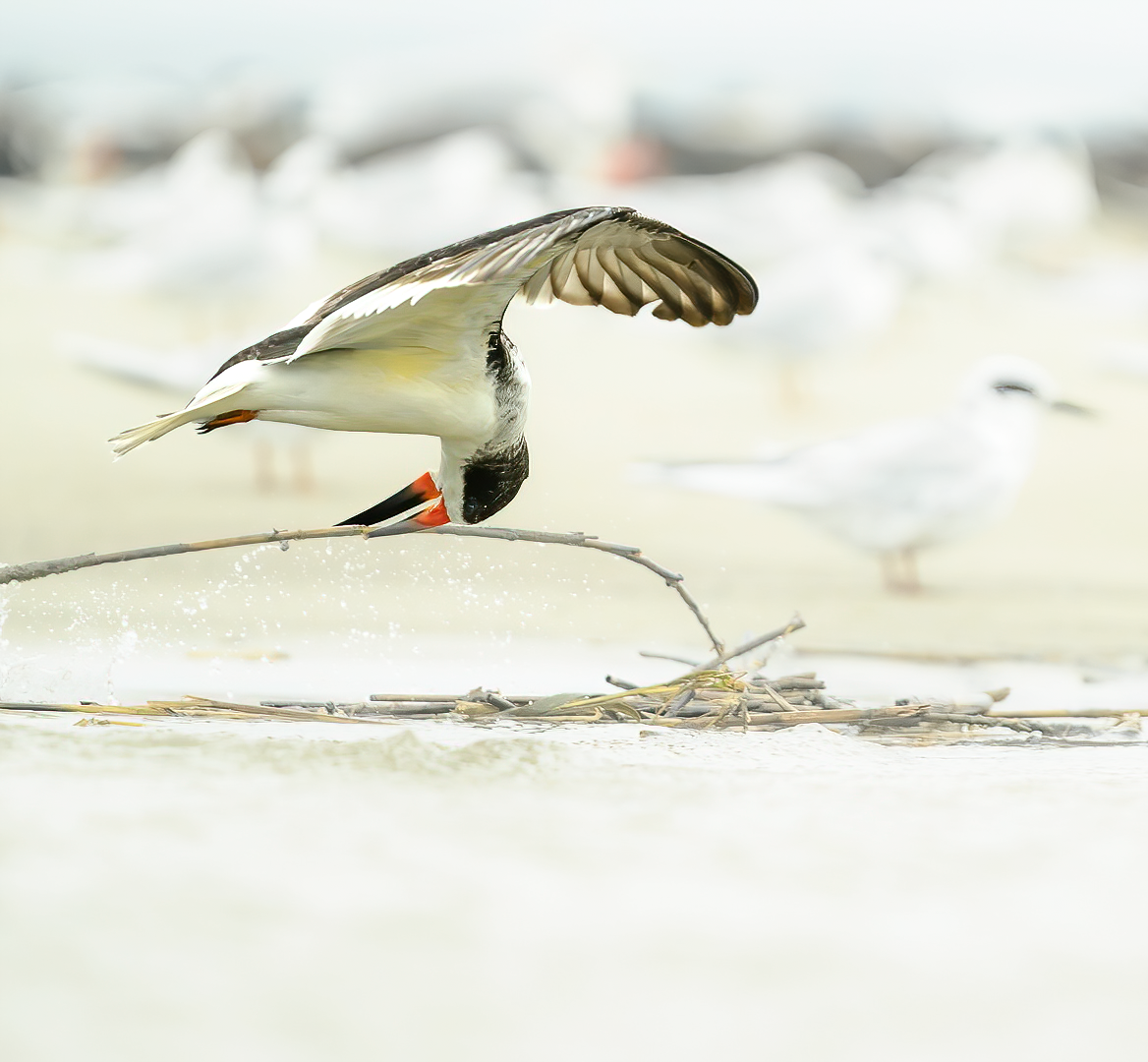
At left, a skimmer draws its lower bill through a shallow pool. At right, a bird’s bill meets a stalk at the wrack line
November is well past nesting season here in South Carolina, although I did come across one memorable account of a Black Skimmer carrying a stick during courtship. At a Virginia nesting colony, ornithologist Olin Sewall Pettingill Jr. watched a male offer his mate a six-inch piece of driftwood. She took it from his bill and set it down. What made that little scene possible to interpret was that Pettingill saw what happened to the stick next.
I believe the skimmers carrying cordgrass were juveniles, too. Watching them fly back to the clump where the young bird was poking among the stems, I had the sense they were practicing, with perhaps a little play mixed in.
Those skimmers reminded me why I love going out in some of the worst weather we get on this coast. I go looking to see where the birds have found shelter, and sometimes I come home with a photograph I never would have imagined taking. The next time I see an adult skim a tidal creek and come up with a fish, I’ll think of that November bird at Fish Haul, flying just as gracefully with a stalk of grass longer than itself.
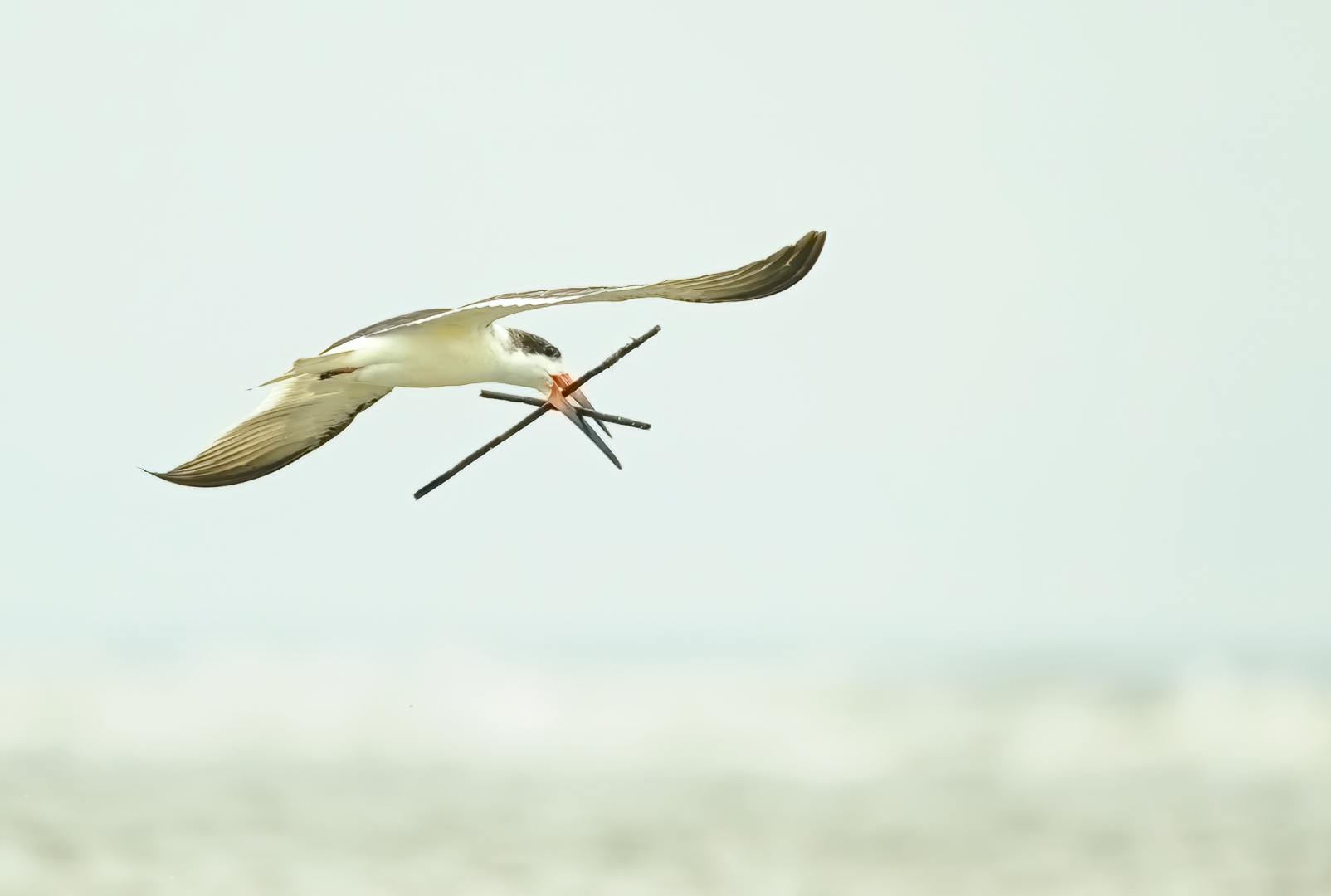
Two stems cross at the open bill of a skimmer in flight.