
Beartooth Highway, Montana
Clouds covered the valley when I left Red Lodge at nine that September morning. I was staying there for two weeks, and this was my first drive up the Beartooth Highway. A local guide had told me the clouds could make for a spectacular photographic opportunity.
The long switchbacks carried me up the first ascent from Rock Creek Valley toward Rock Creek Vista. Looking at the road crossing the mountainside, I wondered how anyone had managed to build it.
Construction began in 1931, and the highway officially opened on June 14, 1936. The federal Bureau of Public Roads oversaw the work, with the National Park Service contributing landscape design and private contractors building the route. On the Red Lodge side, Morrison-Knudsen crews drilled and blasted rock, then used power shovels to cut and shape the road up the canyon wall. Many of the laborers were local men, including laid-off coal miners. Built to connect Red Lodge and Cooke City with Yellowstone’s northeast entrance, the highway also offered new hope for tourism as mining declined.
The highway takes its name from the Beartooth Mountains, named for the Bear’s Tooth, a jagged rock spire resembling a bear’s tooth. Even the name draws attention to a small feature within this immense landscape.
As I climbed into and above the clouds, another question began to take shape: how would I photograph a landscape this large?
Go wide, or go small? How much needed to be in the frame to express what I was seeing and feeling?
At Rock Creek Vista, the aspens were just beginning to turn. Their yellow leaves stood out against gray rock and cloud. In my color photograph, that small patch of warmth gives my eye a place to settle within the mountainside.
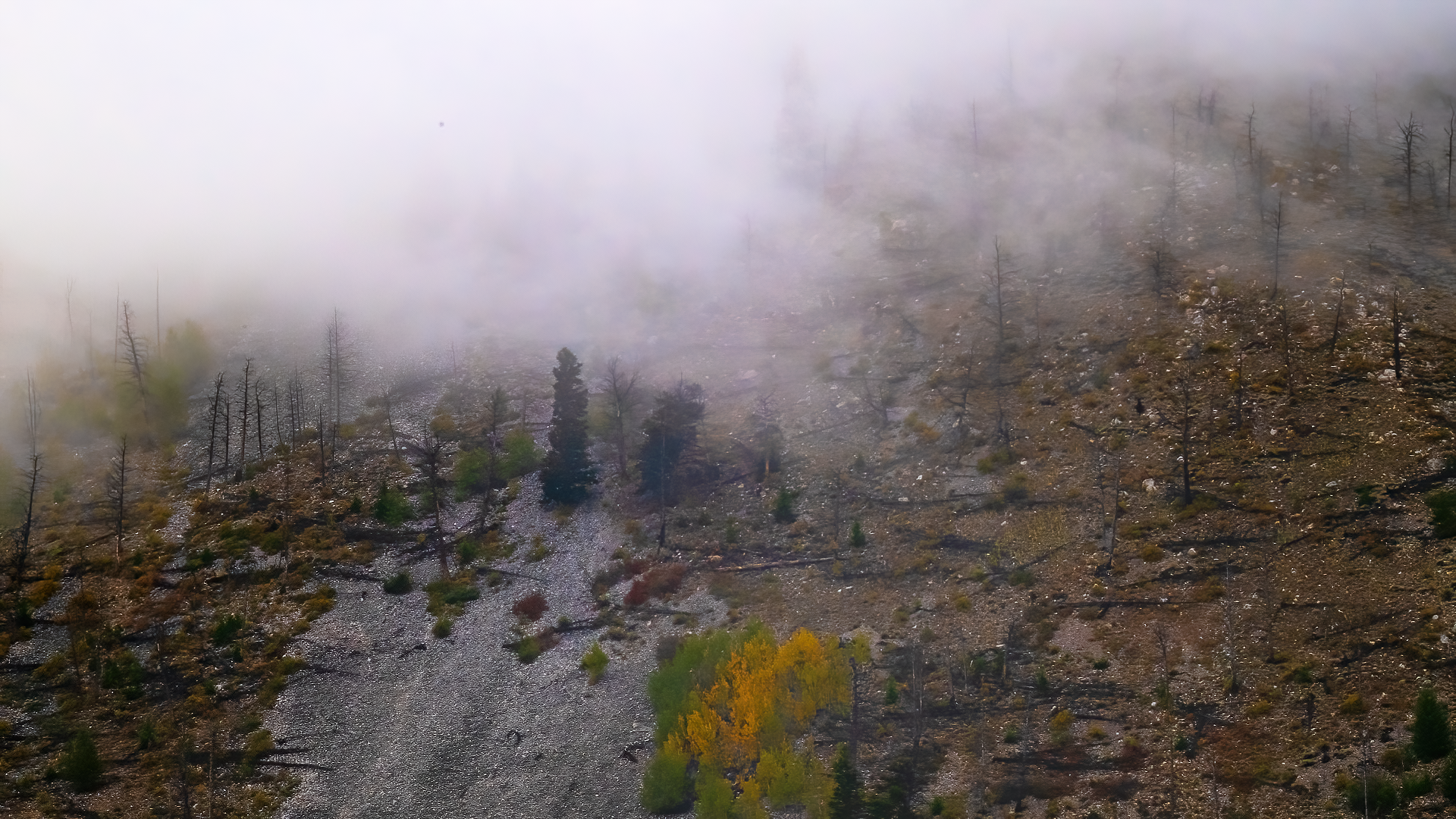
Aspens beginning to turn beneath low clouds, photographed from Rock Creek Vista on the Beartooth Highway, Montana.
But it was the movement of the clouds that held my attention. They rolled up the mountainside like waves arriving on a beach. Unlike waves, they did not retreat. They thinned as they climbed, revealing portions of the slope.
I focused on that meeting of cloud and mountain. The black-and-white photograph brings their contrasting forms forward: the dark, rugged slope and the pale clouds crossing it. My eye follows the rising diagonal of the mountain through those shifting layers.
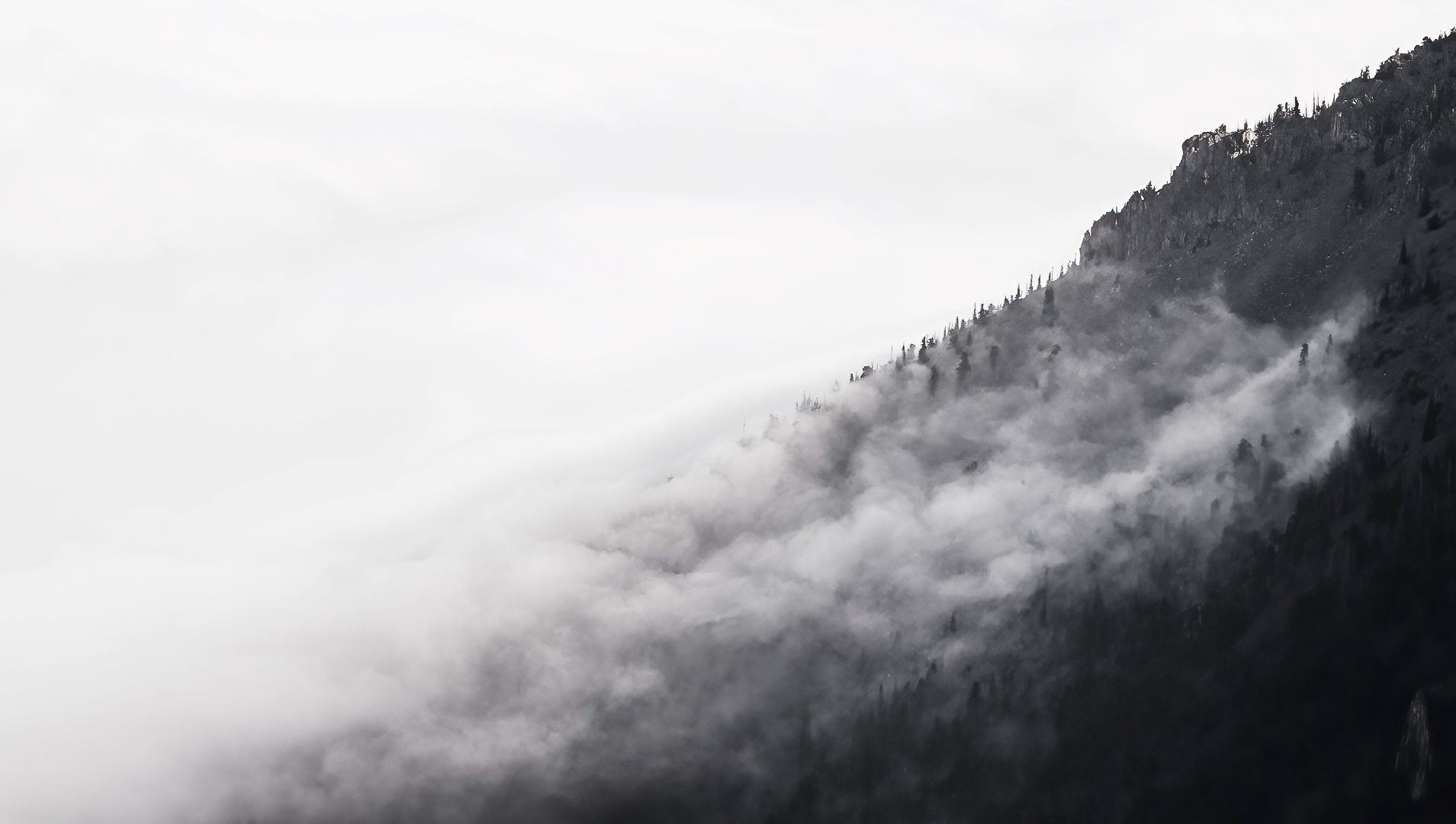
Clouds rising along a forested mountainside, viewed from Rock Creek Vista.
The two photographs tell different parts of the same morning. Color draws attention to the changing season. Black and white emphasizes the clouds, the slope, and the space between them.
Ansel Adams put it simply: “Photography is a way of telling what you feel about what you see.”
That thought brings me back to a phrase I had been using for my photographs from this trip: “I wanted to feel things, to paint in color and mood.”
George S. Mickelston Trail Black Hills, South Dakota
South Dakota’s George S. Mickelson Trail stretches 109 miles between Deadwood and Edgemont, following a former railroad route through the Black Hills. Completed in 1998, it is named for Governor George S. Mickelson, who championed the conversion of the railroad into a recreational trail.
From Hill City, I rode 22 miles round trip, heading north along the trail before turning back. The ride took me through the Black Hills National Forest, past quaking aspens and ponderosa pines. It was very quiet, and the silence felt magical—almost ethereal. There was something soulful and joyful about that beautiful silence.
Along the trailside grew smooth blue asters and small yellow flowers identified as Oregon sunshine, also called golden yarrow, a member of the daisy family.
The aspens’ small yellow leaves, almost round with a distinct point at the tip, fluttered in the wind, making a soft rustling sound I found so pleasant and soothing. Their flattened leafstalks let them tremble in even a light breeze—the movement that gives quaking aspens their name.
Northern Flickers added their voices to the rustling leaves. I encountered many flying across the bike trail and saw them scurrying on the ground among the aspens and fallen tree limbs. In the meadows, they appeared to be feeding. I also heard and saw Mountain Bluebirds in the trees and meadows. Brewer’s Sparrows perched on fence posts, and I also spotted a Clay-colored Sparrow.
I also added two life birds that day. The highlight was a Red-naped Sapsucker, which I spotted in a ponderosa pine. The other was a Western Flycatcher—the Cordilleran form I recorded in my journal—a bird of shaded mountain woodland.
In the aspen photograph, the pale trunks remain recognizable, but their edges soften into greens and yellows. The image has the looseness of a painting. Looking at it, I remember the movement of the leaves, their soothing sound, and the quiet joy of that ride.
The ponderosa pine photograph offers a different kind of attention. The needles radiate from a central point, giving the eye a pattern to follow. Behind them, soft circles of light and color remain part of the picture. The background contributes to its mood even where detail disappears.
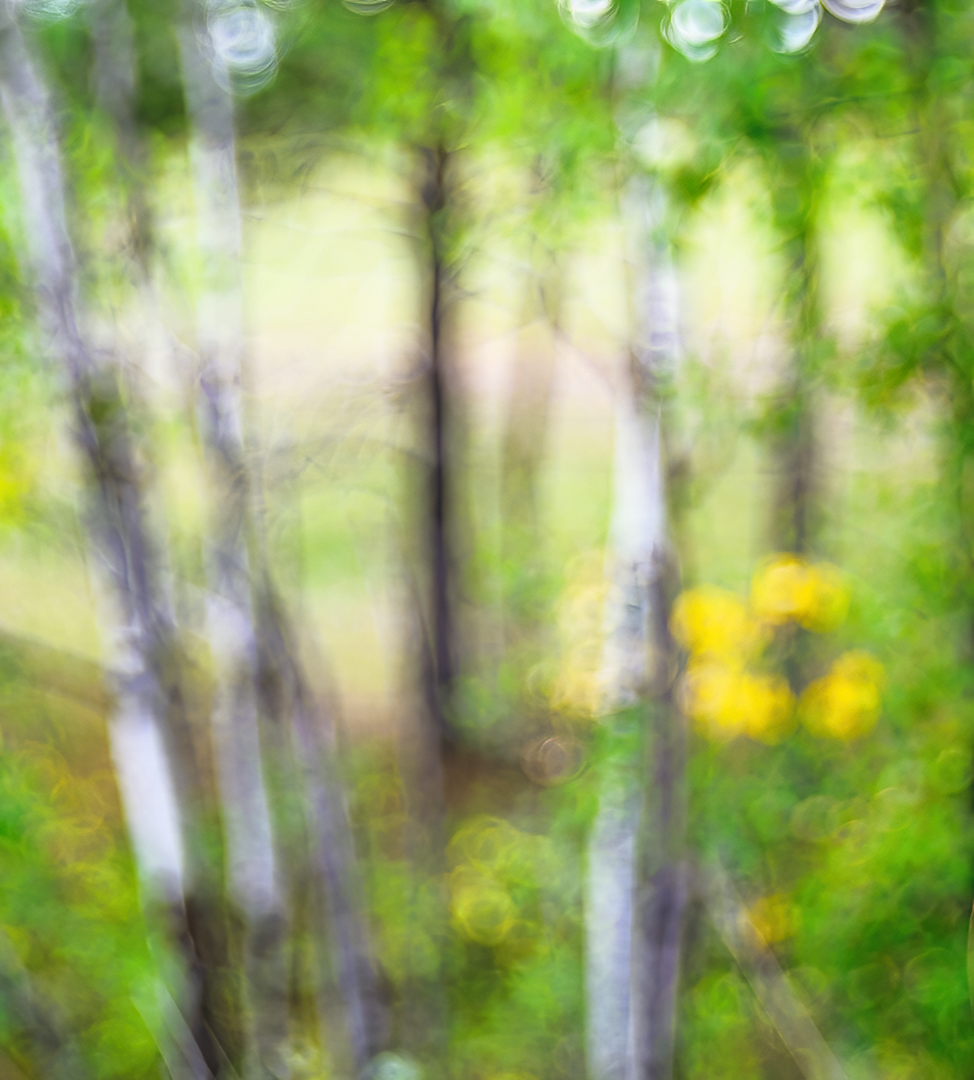
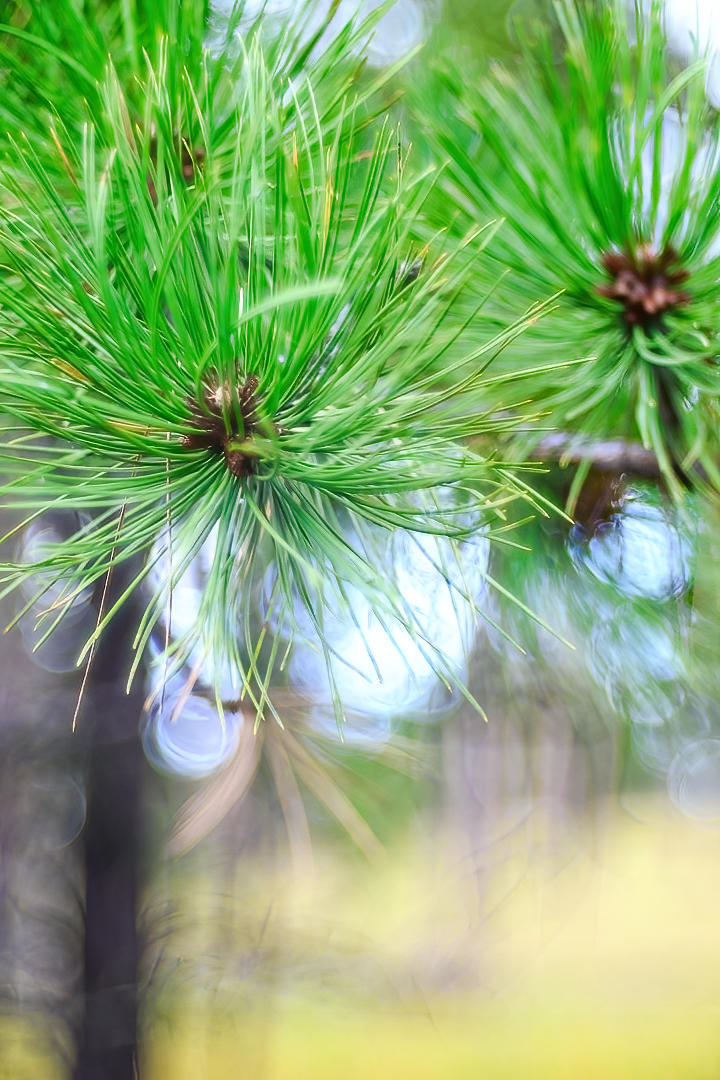
Left: Quaking aspens along the Mickelson Trail, South Dakota. Right: Ponderosa pine needles along the trail.
Looking at these together, I find another question alongside “go wide or go small”: how much detail does a photograph need to carry the feeling of a place?
Greenough Lake Red Lodge, Montana
At Greenough Lake, near Red Lodge, the morning arrived slowly. I got there around nine, more than 7,000 feet above sea level, but the sun had yet to clear the ridge to the east. The lake, meadows, and forest were still in shadow. Along the trail, Rock Creek ran beside me, its clear water roaring over the rocks.
I thought of the song “You’ll Never Leave Harlan Alive” and its imagery of “when the sun comes up about 10 in the moring”. Here, too, the mountains held back the sun.
Lodgepole pines, subalpine firs, and spruce stood along the way. Aspen saplings blanketed parts of the landscape, their leaves beginning to turn yellow. In the meadows, tall fireweed stems had taken on reddish-orange tones. Silvery sagebrush, red rosehips on wild rose shrubs, and the fragrance of common juniper added to the colors and sensations of the trail.
Some plants left me with questions in my journal: a grass I thought might be bluejoint reedgrass, small purple bell-shaped flowers, and woolly white flower heads above low rosettes among the pine needles—perhaps pussytoes. I was still learning their names, but their shapes and colors were already catching my attention.
A BLM sign marked a “Bearing Tree,” a reference tree used by land surveyors to help locate a survey corner. It was another small detail that made me stop and look.
I heard magpies and American Robins, and a Belted Kingfisher sounded as though it had claimed the lake. Bear scat lay along the trail. At the water, a moose and calf drank from the lake. A squirrel seemed to be in a feeding frenzy, jumping from tree to tree and foraging for pine cones as winter approached. Dragonflies moved over the lake, and trout broke the surface. Evidence of the wild was everywhere.
A conversation with a local fisherman added to an already magical morning. He told me about growing up on a dairy farm in North Dakota and remembered Whooping Cranes stopping to feed at his uncle’s farm during their southward migration. I came away with his recollection of a time when only about twenty remained. His memory echoed a precarious chapter in the species’ history. In 1941, just fifteen Whooping Cranes were counted in the migratory flock wintering at Aransas in Texas. North Dakota’s fields and wetlands remain important places for those cranes to stop and feed.
As the sun began to reach into the valley, golden light filtered through the pines in patches. It caught the rocks and reflected in still pools along Rock Creek below. On the steep mountain slopes, small patches of autumn color appeared against the rock, including a few aspens turning yellow. My attention moved between those larger views and the smaller places where light and color met.
In the sagebrush photograph, fine branches emerge through pale, soft foliage. Some lines are clear enough to follow; others disappear. The muted greens and grays give the photograph a quiet feeling.
The small fir has a more distinct presence. Its green needles stand against broad areas of yellow and blue, with darker tree trunks behind. Here, the background is a substantial part of the composition. It surrounds the little tree with color while leaving its shape easy to see.
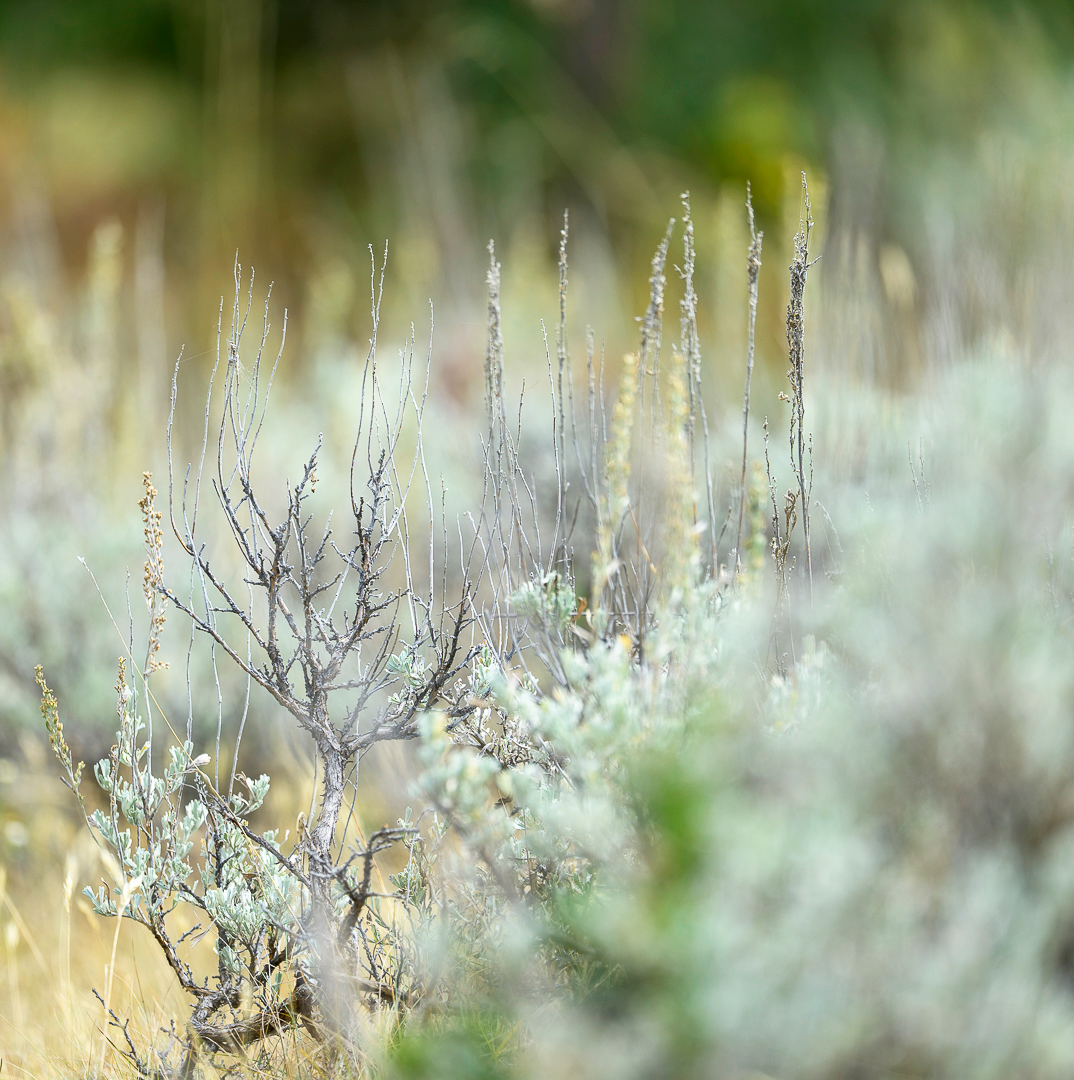
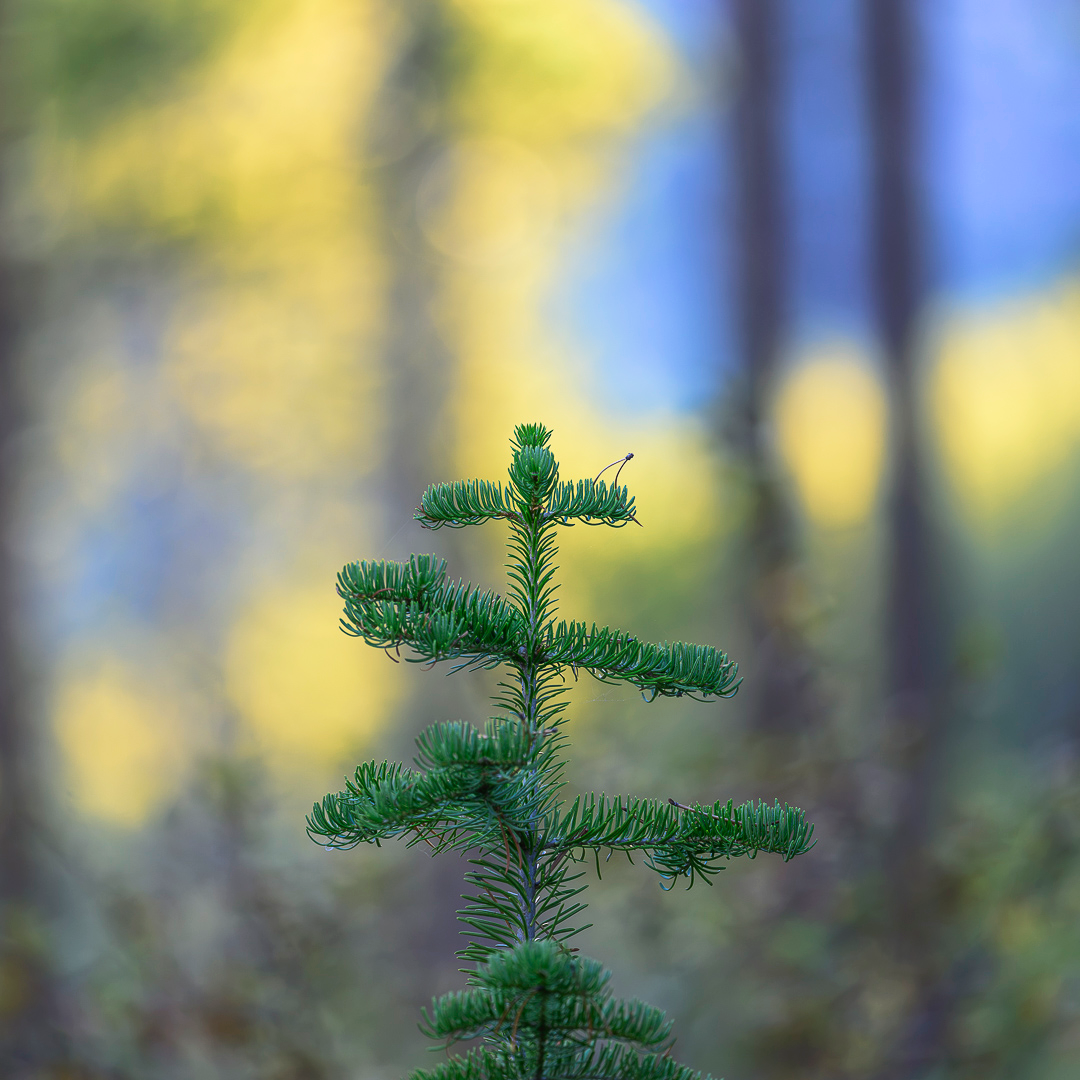
Left: Sagebrush in the Greenough Lake area. Right: A subalpine fir against a soft background of yellow, blue, and green. Near Red Lodge, Montana.
Both photographs hold my attention through the relationship between a small, defined subject and the softer world around it. What falls out of focus still matters.
In another image, a strip of pine bark occupies the right side of the frame. The yellow circle to its left is the rising sun, photographed through the woods. The bark is sharply textured; the sun and the forest beyond are soft. Looking at it, I remember that morning’s gradual passage from shadow into light.
Then there is the photograph in which almost everything softens. Dark vertical forms suggest trees, but the eye has little sharp detail to hold. Yellow, blue, and green become the subject. Looking at it, I return most directly to that idea of painting in color and mood.
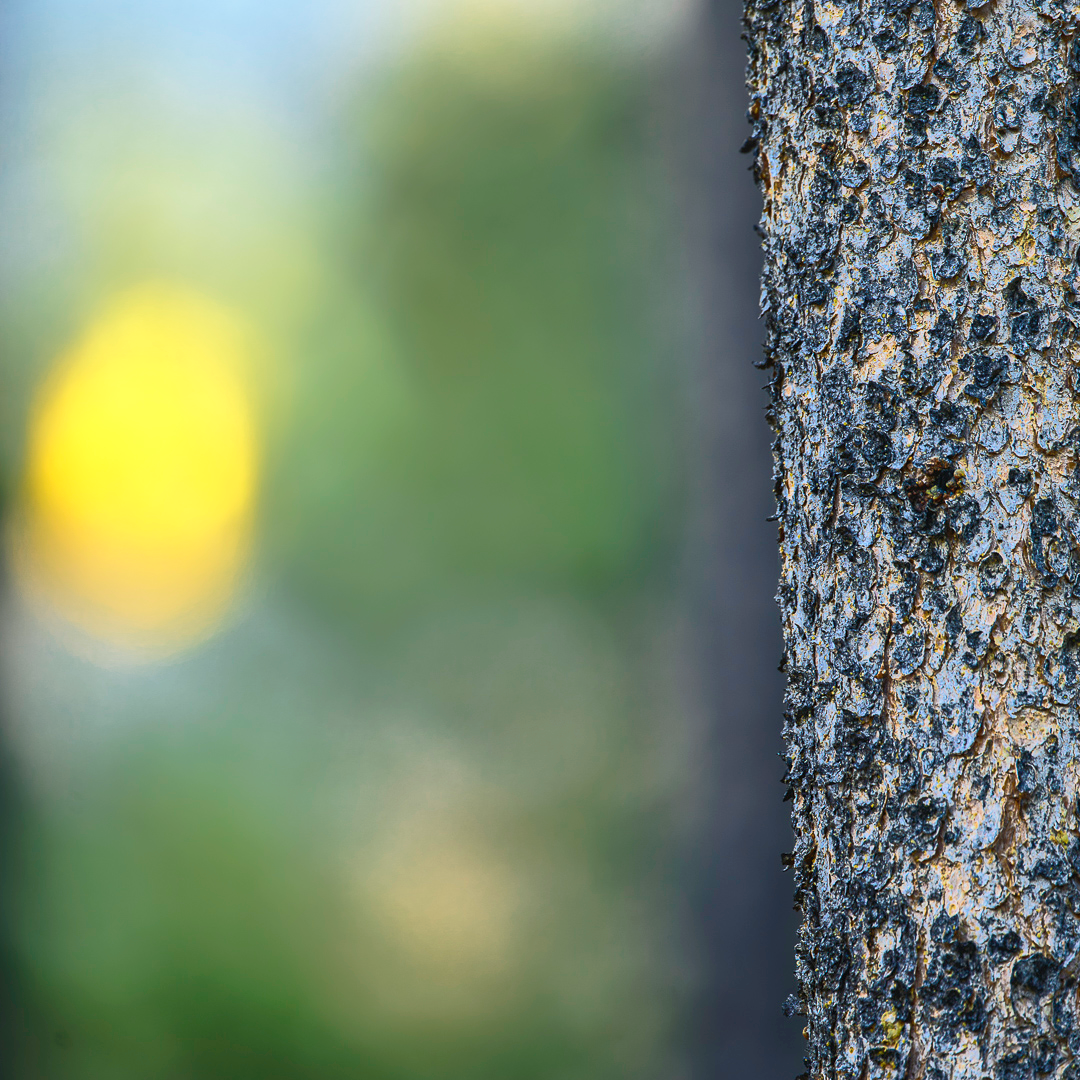

Left: Pine bark and the rising sun photographed through the woods near Greenough Lake. Right: An abstract view of woodland shapes and color at Greenough Lake.
Placed together, these images invite a slower look. The first offers a surface I can almost feel. The second leaves more for me to imagine.
The yellow leaves in the final photograph bring me back to a small, recognizable subject. Their curled edges stand against a softened gray boulder, while yellow fills the foreground. That relationship between warm color and gray echoes the aspens on the Beartooth mountainside.
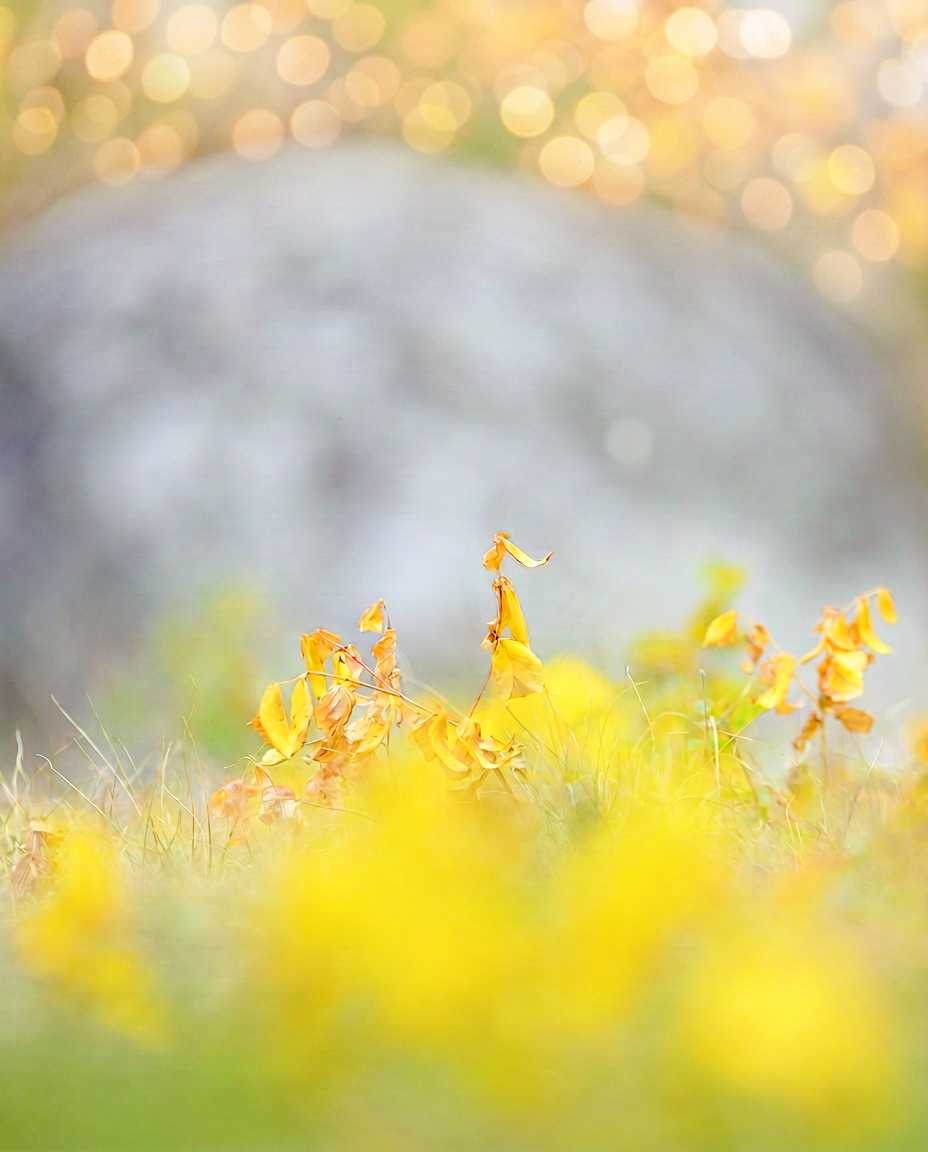
Yellowing leaves in front of a softly rendered boulder, Greenough Lake, near Red Lodge, Montana.
These choices—what to include, where to direct attention, what stays sharp, and whether color contributes—help shape a photograph’s narrative. A broad view can establish the scale of a place. A smaller portion can draw attention to a relationship: bright leaves against gray rock, or soft clouds crossing a rugged slope.
On your next outing, pause over what catches your attention. Is it the size of the landscape, a small patch of color, a pattern, or something moving? Try framing that subject broadly, then more tightly. Notice what each version emphasizes and what disappears. Pay attention to the background, too: does it support the subject or pull your eye away?
When you review the photographs, ask which one comes closest to expressing what made you stop. For me, that morning on the Beartooth Highway, it was the clouds climbing the mountain.