
The Wood Thrush at Dawn: Light and Song
Field notes from the southern Blue Ridge Mountains
“The Wood Thrush is not an especially shy bird, but as its days are spent in thick underbrush, it must be looked for to be seen. In common with the other thrushes of this genus it seems to dislike direct sunlight, rarely leaving the dense shade of the thickets it inhabits. This attitude is reflected in its activities, for during much of the day it is quiet and inconspicuous, and only in the early morning hours and again in the late afternoon can its song usually be heard. It is generally agreed that the liquid, unhurried song of the Wood Thrush is equalled by few other birds, and when heard at twilight on a summer evening, it leaves an impression not soon forgotten.”
—Thomas D. Burleigh, Georgia Birds (1958)
Sunrise Bokeh No. 1
A Voice Before the Light
An old ornithological description encountered again as a living experience in the same Georgia landscape nearly seventy years later. My field notes, photographs, video, and Burleigh excerpts each contribute a different layer—place, sound, observation, and historical perspective.
At dawn, before sunlight reached the deck, the Wood Thrush was already singing. The cabin sits at approximately 1,700 feet in the southern reaches of Georgia’s Blue Ridge Mountains, between Ellijay and Cherry Log. It is set back in the woods on a steep hillside, with the deck facing northeast. Jones Creek runs below, at the bottom of the slope.
Above it came the flute-like song of the Wood Thrush—loud, clear, soulful, and beautiful. The bird sang from somewhere high in the canopy, concealed deep within the foliage, yet its presence was unmistakable. Its song arrived in measured phrases, each followed by a pause long enough for the notes to linger and reverberate through the ravine. The song did not break the stillness of the morning; it seemed to belong to it, as though the Wood Thrush’s voice could be fully heard only in such quiet.
Wood Thrush Song at Dawn
Nearly seventy years earlier, ornithologist Thomas D. Burleigh described the Wood Thrush as “a bird of the wooded ravines and thicker woods.” The habitat outside the cabin seemed almost to answer his description. Thick vegetation covers much of the slope, while Eastern White Pines, Red Maples, Hickories, Tulip Poplars, and Black Tupelos form a layered canopy above it. Even after sunrise, much of the lower forest remains shaded. This was not simply a place where a Wood Thrush happened to be singing. It was the kind of place Burleigh said the bird inhabited.
Why Sing at Dawn?
Burleigh’s observation about the timing of the song also remains accurate. According to the Cornell Lab of Ornithology, the male Wood Thrush is among the first songbirds heard in the morning and among the last in the evening. It typically sings from the midstory or lower canopy, using a voice that carries through dense forest to announce and maintain its territory.
Why dawn and twilight?
Ornithologists have not identified one explanation that applies to every bird or every habitat. In their review of dawn-chorus research, ornithologists Diego Gil and Diego Llusia describe several likely factors working together. Dim light and cooler temperatures can make dawn a relatively poor time for feeding, particularly for birds searching visually for insects. Singing may therefore interfere less with foraging during those first low-light minutes than it would later in the morning. At the same time, song performs important social functions, including communicating territorial ownership and reproductive status. The same tradeoff may occur in reverse at twilight, as fading light once again makes visual foraging more difficult.
A bird’s ability to see in low light may also help determine when it begins singing. Comparative research has found that songbirds with relatively larger eyes tend to start singing at lower light levels than species with smaller eyes. Light does not fully explain the dawn chorus, but it clearly helps set its timing.
The science supports Burleigh’s description, but it also argues against reducing the dawn chorus to one simple cause. It is a meeting point of light, feeding opportunity, physiology, territorial communication, and breeding behavior.
That morning, I did not think about those factors separately. I simply heard the Wood Thrush singing while the woods were still dark.
Light Moving Through the Woods
Sunrise at the cabin is not an unobstructed event. There is no open horizon beyond the deck. The sun must find its way through the forest.
At first, the woods remain almost entirely in shadow. The trunks are dark vertical forms, and the foliage appears in deep shades of green and blue. Then small openings begin to appear between the leaves. Light reaches the upper canopy first, catching the edges of branches and turning individual gaps into points of gold.
The forest does not brighten all at once. The light moves.
It slips between Eastern White Pine needles and the broad leaves of Tulip Poplars. It passes through Red Maples, Hickories, and Black Tupelos, appearing for a moment and then disappearing as branches move. On the deck railing, it forms narrow bands of orange. Deeper in the woods, a single opening can become a bright white center surrounded by blue, green, and gold.
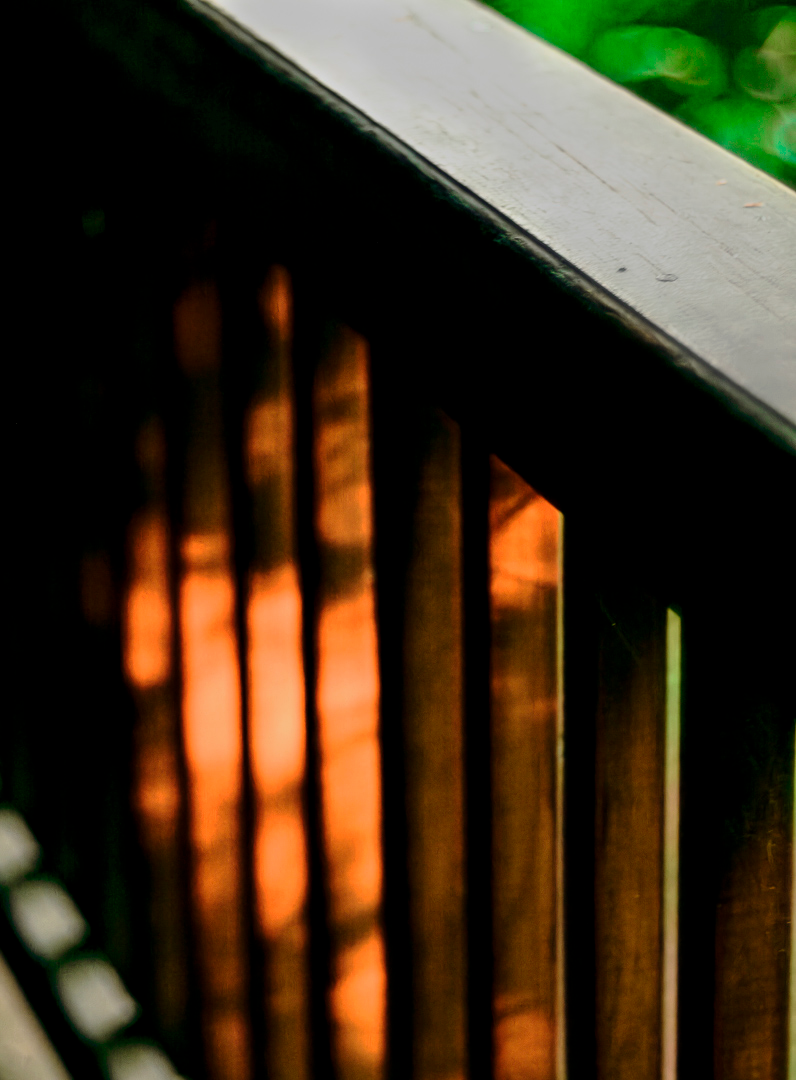
Morning light reflected across the deck railing as the sun moved between the trees.
The photographs I made that morning are not literal records of individual trees. I was photographing the experience of light passing through the woods.
Leaves and branches softened. Gaps in the canopy became overlapping circles. Colors separated and then merged again—cool blue shadows beside warm orange light, deep forest green beside sudden yellow. In some photographs, the sun appears as a distinct point. In others, it dissolves into the surrounding foliage.
Sunrise Bokeh No. 2
The shifting patterns lasted only briefly. A small movement of a branch changed the entire scene. A bright opening closed. Another appeared farther down the slope. What looked golden one moment returned to shadow the next. The photographs hold fragments of that movement. They do not show the woods as the eye might catalogue them. They show how the woods felt while the Wood Thrush was singing.
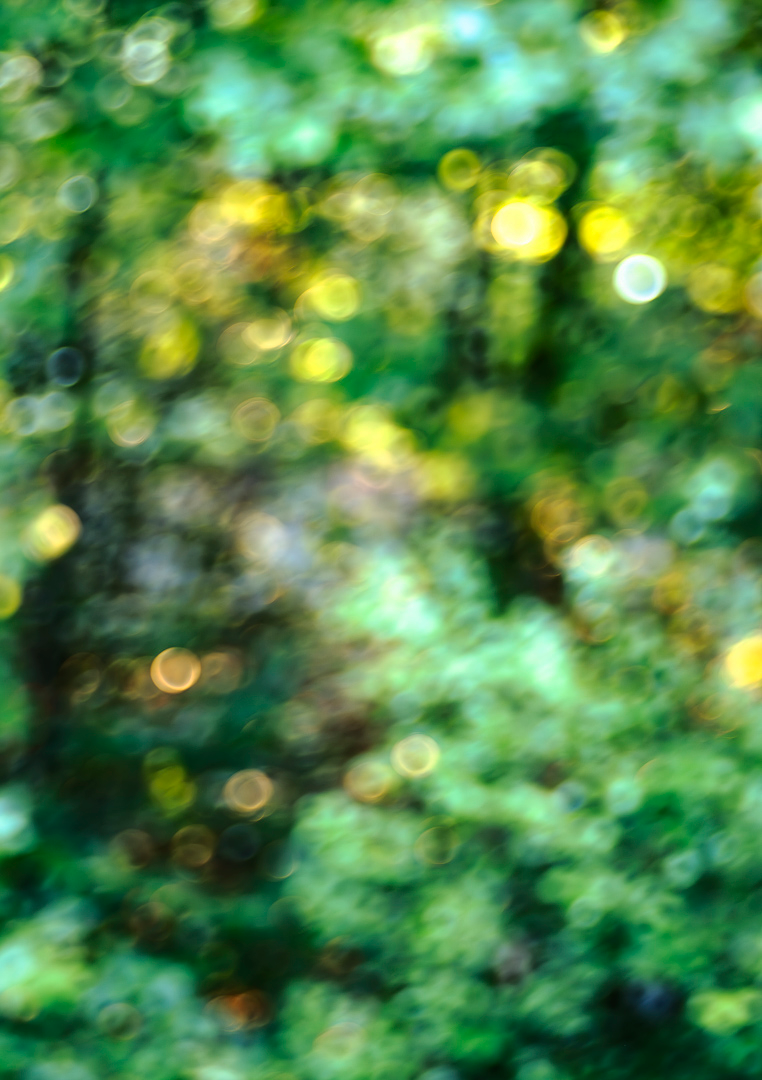
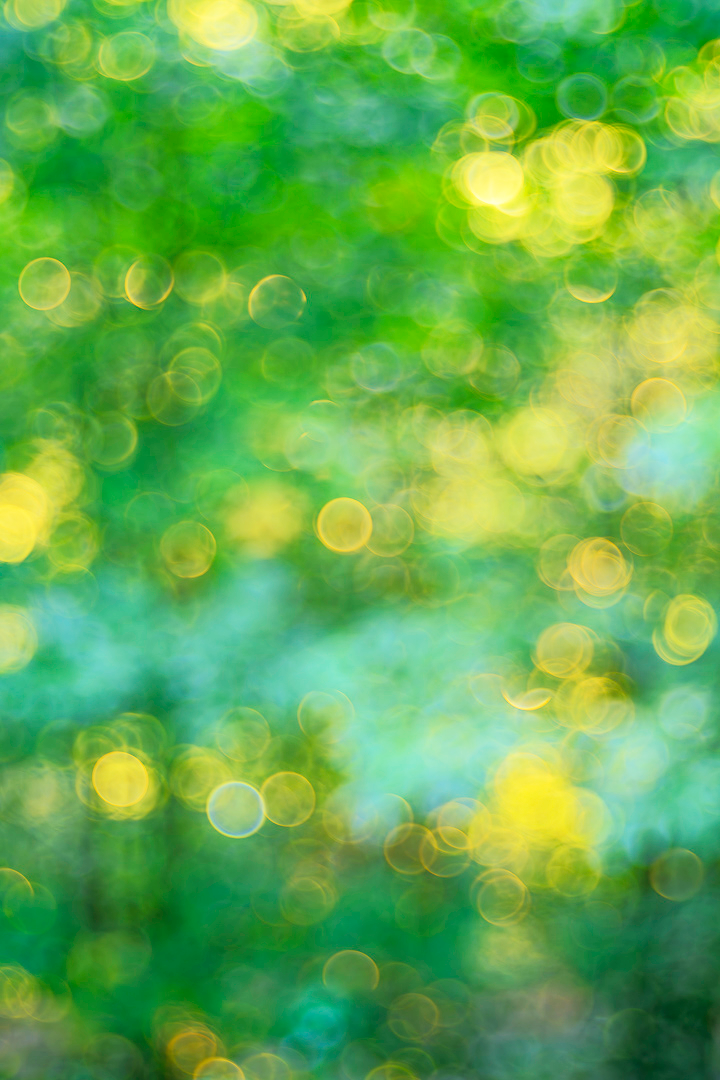
The song came from the shaded interior of the forest, while sunlight moved across and through the leaves, branches, trunks, and understory. One revealed the depth of the woods through sound. The other revealed its structure through light.
As Daylight Entered the Forest
As the sun rose and daylight began to fill the woods, the Wood Thrush’s song became less frequent. But, the woods did not become quiet.
A broader chorus took its place: Carolina Wren, Red-eyed Vireo, Red-bellied Woodpecker, Northern Cardinal, White-eyed Vireo, American Robin, Tufted Titmouse, Red-shouldered Hawk, Scarlet Tanager, and Yellow-throated Vireo.
The Wood Thrush had defined the edge of day. With stronger light, the rest of the woodland community came forward.
Some voices were emphatic and close. Others came from high in the canopy or farther down the slope. The birds were not singing in a coordinated performance, yet together they gave the forest depth. Each voice occupied a different distance, height, and part of the surrounding vegetation.
One voice, however, did not fade as the morning advanced.
The Red-eyed Vireo continued singing throughout the day, including well into the mid-afternoon. That persistence is characteristic of the species. The Cornell Lab describes breeding male Red-eyed Vireos as singing from before sunrise until well into the afternoon. One individual observed in Ontario in 1952 delivered 22,197 songs between dawn and evening—an extraordinary count that helps explain why the species is sometimes called the “preacher bird.” My mid-afternoon bird was therefore doing exactly what Red-eyed Vireos are known to do: continuing its steady declaration while much of the forest had become quieter.
Three Vireos in One Morning
Hearing three species of vireos—Red-eyed, White-eyed, and Yellow-throated— was one of the most interesting parts of the morning.
Although related, the three are associated with different parts of the woodland.
The White-eyed Vireo is most closely associated with dense shrubs, tangled understory, and thickets. It can remain difficult to see even when singing nearby. Cornell describes it as a bird that forages largely out of sight but sings through much of the day, including during the heat.
The Yellow-throated Vireo is more strongly associated with open deciduous woods, forest edges, and the inner branches of the canopy. Its song can resemble that of the Red-eyed Vireo, but it is slower and burrier. Males repeat those phrases throughout the day, often while remaining on a relatively stationary perch.
The Red-eyed Vireo generally sings from higher in deciduous and mixed forest canopies. It can be extremely difficult to see among summer leaves, but its persistence makes it one of the most recognizable voices of an eastern forest.
Together, the three species gave the woods an audible vertical structure: the White-eyed Vireo associated with the dense lower growth, and the Yellow-throated and Red-eyed Vireos occupying different parts of the forest canopy.
They also represent different migration strategies.
The Red-eyed Vireo is a long-distance migrant. It is a summer resident of eastern North American forests, but in fall it leaves the United States and Canada for wintering grounds in the Amazon basin of South America.
The Yellow-throated Vireo is also a long-distance migrant. Its presence in the North Georgia woods belongs primarily to the breeding season; it departs for tropical wintering areas after summer.
The White-eyed Vireo has a more flexible pattern. Cornell classifies it as a resident-to-short-distance migrant. Some populations remain throughout the year in southern and coastal portions of the United States, while others move into Mexico, the Caribbean, and Central America for winter. Based on that range pattern, the White-eyed Vireo in the North Georgia mountains is best understood primarily as a summer resident and migrant rather than a dependable year-round woodland bird.
The three voices were therefore distinctly seasonal. The Red-eyed and Yellow-throated Vireos would eventually leave on long southbound journeys. Most White-eyed Vireos from the interior would also withdraw toward warmer regions.
For that morning, however, all three were present within the same patch of woods.
Listening Across Time
In Georgia Birds, Burleigh described the Wood Thrush as a common summer resident throughout the state, found in suitable habitat from the mountain counties to the Florida line. His list of Georgia locations is broad, but the phrase that stayed with me was much more specific: “a bird of the wooded ravines and thicker woods.” From my perrch, I could hear exactly what he meant.
The bird did not need to appear in the open. Its song carried upward from the shaded woods and gave shape to a part of the forest I could not fully see. The video records the sound. The photographs record the changing light. Burleigh’s words connect both to a much longer history of people listening to Wood Thrushes in Georgia.
Yet the historical connection is not entirely reassuring. Although the Wood Thrush remains a familiar summer voice in suitable eastern forests, its population has declined substantially. North American Breeding Bird Survey data cited by the Cornell Lab indicate an estimated cumulative decline of approximately 45 percent between 1966 and 2023. Habitat fragmentation on both its breeding and wintering grounds is among the pressures affecting the species.
Burleigh’s account therefore offers more than confirmation that Wood Thrushes have long inhabited Georgia’s wooded ravines. It also provides a baseline—a record of how common and widespread the bird appeared in the middle of the twentieth century.